
Why Ignoring Your Money's Growth Potential is Costing You Sleep
Ever catch yourself staring at your bank app, wondering why your savings barely move while the price of groceries just keeps going up? Trust me, I know that sinking feeling. You work hard, skip the fancy lattes, and try to do everything right—but your money just sits there, losing its buying power. Let’s fix that today. I am going to show you exactly how everyday people build real wealth, and we will do it without using any confusing Wall Street jargon.
So many regular hardworking people face this exact same emotional burden every single day. You go to work, you earn your paycheck, and you try to be responsible by putting some cash away in a safe place. But soon, you realize that simply hiding cash under a mattress or keeping it in a basic checking account is not enough. The cost of groceries goes up, housing becomes more expensive, and your hard-earned savings slowly lose their buying power.
You might be asking yourself, "Am I doing something wrong?" The short answer is no, you are just missing one highly important piece of the puzzle. The rich do not just work for their money; they make their money work for them.
Let's look at a very common scenario. Imagine two friends, Sarah and Mark. Both work at the same company and make the exact same salary. Mark saves a portion of his money in a standard account, happy to just see the number stay the same. Sarah, on the other hand, puts her money into an account that earns interest.
Over a few months, Mark thinks he is doing fine. But after several years, Sarah's account is completely outperforming Mark's, even though they saved the exact same amount of money. Mark feels stressed and confused, while Sarah feels financially secure. This simple difference in strategy is exactly what separates constant financial struggle from genuine peace of mind.
Quick Reality Check: Myth vs. Fact
- The Big Myth: You need thousands of extra dollars sitting around to start investing.
- The Honest Fact: You can start with just $5 a week. Getting started early with a tiny amount always beats waiting ten years to invest a large lump sum. It is about building a daily habit, not having a massive bank account.

Your Quick Wealth-Building Cheat Sheet
- Make Time Your Best Friend: Starting today with a small amount puts you miles ahead of waiting for the "perfect time."
- Use the Rule of 72: Divide 72 by your interest rate to instantly know how many years it takes for your money to double.
- Automate Everything: Set up your accounts to save and reinvest automatically so you never even have a chance to spend the cash.
- Kill Toxic Debt First: Always clear out high-interest credit card debt before trying to grow your long-term savings.
The Hidden Mechanics Behind Growing Your Wealth Passively
To truly solve this problem and remove that constant financial stress, we need to look at how money can actually multiply itself over time. You do not need a degree in finance to understand this concept. In fact, the math behind it is incredibly straightforward once you break it down into simple, relatable pieces.
We are talking about earning interest on top of your interest. Think of it like a snowball rolling down a long, snowy hill. When the snowball starts at the very top, it is small enough to fit in the palm of your hand.
As it rolls down the hill, it picks up a little bit of snow. But as it gets bigger, it has a larger surface area, meaning it picks up even more snow with every single rotation. By the time it reaches the bottom of the hill, that tiny ball has become a massive, unstoppable boulder.

This is exactly how your money should behave. When you put money into an investment or a high-yield account, it earns a little bit of extra money. Then, in the next period, you earn money not just on your original deposit, but also on the extra money you already earned.
This simple repeating cycle is what turns small, consistent savings into massive long-term wealth. Let's look at a clear comparison to make this perfectly easy to understand.
Simple Interest vs. Earning on Top of Earnings
Looking at this table, it becomes obvious why the second method is the clear winner for anyone wanting to secure their financial future. The simple act of leaving your money alone to multiply is the biggest secret of successful investors.
I used to think I needed thousands of dollars to start, but my biggest realization was that time is actually much more valuable than a massive initial deposit. I started with just a few dollars a week, and watching that small amount generate its own tiny earnings completely changed my mindset about saving.
The Most Important Factor You Can Control Right Now
Watch this incredibly helpful breakdown before we move on to the next step. It visually explains exactly how small amounts turn into massive results over time!
Now that you understand the basic concept, we need to talk about the absolute most important ingredient in this entire recipe. That ingredient is Time. Time is the magical element that makes the snowball effect possible.
Let's imagine a real-world example to show you exactly why starting today is so much better than waiting for tomorrow. We will call this the tale of the Early Bird and the Late Bloomer.
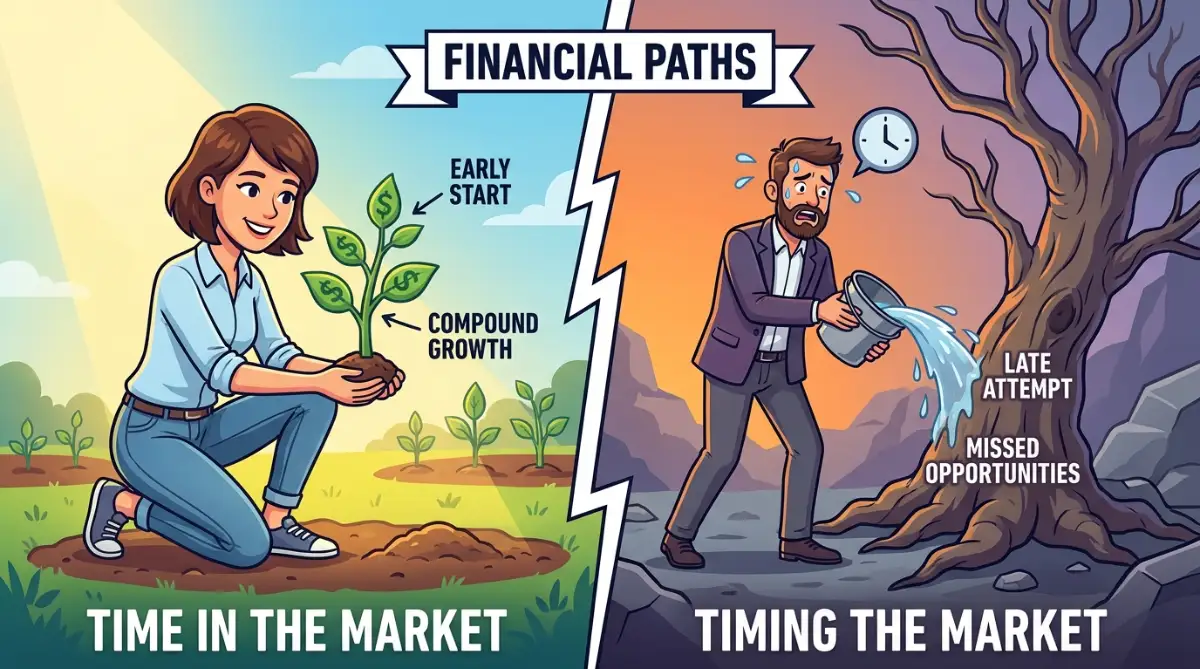
Alice understands the power of starting early. At age 25, she decides to invest just $200 a month into an account that grows over time. She does this for exactly 10 years and then stops completely at age 35. She never puts another dime into that account, but she leaves the money there to grow.
Bob, on the other hand, wants to wait until he feels more "settled" in his career. He waits until he is 35 to start saving. Realizing he is behind, Bob also invests $200 a month, but he has to keep doing it every single month for 30 years until he reaches age 65.
When they both turn 65, something amazing happens. Even though Bob invested his own money for 30 long years, Alice still ends up with more money than him. Alice only put her own money in for 10 years!
How is this even logically possible? It all comes back to the snowball rolling down the hill. Alice's snowball had 40 years to roll down the hill, gathering more and more snow on top of its own weight.
Bob's snowball was heavy, but it only had 30 years to roll. That 10-year head start allowed Alice's early interest to multiply itself so many times that Bob simply could not catch up, even by working three times as hard.
A Simple Mental Trick to Predict Your Money's Future
You might be wondering how long it actually takes for your money to double in size. Financial experts use a very simple mathematical trick to figure this out instantly, without needing a calculator.
It is called the Rule of 72. This is a basic mental shortcut that anyone can use to understand their financial growth.
Here is how it works. You simply take the number 72 and divide it by the interest rate you expect to earn. The resulting number tells you exactly how many years it will take for your money to double.
For example, let's say you find an account that pays a 6 percent return. You just take 72 and divide it by 6. The answer is 12. This means that every 12 years, your money will completely double in size, even if you never add another penny to it.
If you put $5,000 in that account today, it becomes $10,000 in 12 years. In another 12 years, it becomes $20,000. In another 12 years, it becomes $40,000.
This simple trick helps you see the future clearly. It removes the confusing math and gives you a straight, honest look at what your savings can achieve.
Knowing this rule also protects you from bad investments. If a bank is only offering you a 1 percent return, 72 divided by 1 is 72. That means you would have to wait an entire lifetime just to see your money double once.
By understanding this concept, you can easily scan different financial options and choose the ones that actually respect your time and hard work. It puts the power back in your hands.
Think About This Real-Life Example:
Let's say you hide $10,000 under your mattress for 10 years. Because of inflation, everyday items will cost way more a decade from now. That means your hidden $10,000 will actually buy you less stuff than it does today. But if you use the Rule of 72 and park that money in an account growing at 7%, it doubles to $20,000 in about 10 years. You just beat inflation by simply letting your money take a nap in the right place!
How Often Your Money Multiplies Matters
Another important detail to understand is how frequently your interest is calculated. This is often referred to as the compounding frequency. It sounds complicated, but it is actually very easy to grasp.
Imagine you have a fruit tree in your backyard. If the tree only drops seeds once a year, you will slowly get a few new trees. But if that tree drops seeds every single month, those new seeds start growing into trees much faster, which then drop their own seeds.
The same rule applies to your bank accounts and investments. Some accounts calculate your extra earnings once a year. This is called annual compounding.
Other accounts calculate your earnings every single month. This means you earn interest on your interest twelve times a year instead of just once.
Naturally, the more frequently your money is calculated, the faster it grows. When you are looking for places to store your long-term savings, always try to find options that calculate your returns monthly or even daily.
It might seem like a tiny difference at first, maybe just a few extra dollars a year. But over the span of twenty or thirty years, that tiny difference turns into thousands of extra dollars in your pocket, completely for free.
Overcoming the Mental Barrier to Getting Started
The biggest obstacle people face is not the math. The math is simple, as we have just seen. The biggest obstacle is human psychology.
We are wired to want immediate results. When we go to the gym for two days, we want to see muscles in the mirror immediately. When we save money for a month, we want to feel rich right away.
But true wealth building is a slow, quiet process in the beginning. For the first few years, your snowball is very small. The growth might feel painfully slow, and you might be tempted to give up and spend the money on something fun today.
You have to trust the process. You have to remember the story of Alice and Bob. The magic does not happen in the first five years; the massive, life-changing magic happens in years fifteen, twenty, and beyond.
Start by simply automating your savings. Set up a system where a small amount of money is automatically transferred from your paycheck into a growing account before you even see it.
If you do not see the money in your daily checking account, you will not be tempted to spend it. Over time, you will learn to live on slightly less, and your hidden wealth machine will be running quietly in the background, working 24 hours a day to secure your future.
This is not about getting rich overnight. It is about taking back control of your financial destiny, one small step at a time. The simple choice to start today is the most powerful financial decision you will ever make in your entire life.
Pro-Level Strategies to Keep Your Money Machine Running
Now that you understand the basic snowball effect, you are already ahead of most people. But simply knowing how it works is only half the battle. To truly win this game and build lasting wealth, you need to know how to supercharge your results safely.
One of the smartest moves you can make is to automatically reinvest your earnings. In the financial world, this is often called a Dividend Reinvestment Plan, or DRIP for short. Whenever your investments pay you extra cash, you do not put that cash in your pocket.
Instead, you use a setting in your account to automatically buy more of that same investment. This forces your money to compound even faster without you lifting a single finger. The U.S. Securities and Exchange Commission (SEC) highly recommends reinvesting earnings to maximize your long-term growth.
Think of it like planting a garden. When your tomato plant produces seeds, you do not just throw the seeds away. You plant those new seeds right back into the soil to grow even more tomato plants next season.
Automate Your Savings to Beat Human Nature
Let me share a very practical secret with you. Human beings are terrible at remembering to save manually. If you wait until the end of the month to invest whatever cash is leftover, you will usually find that nothing is leftover.
Life always finds a way to spend your spare cash. Your car needs a repair, your friends want to go out for dinner, or a new phone catches your eye. To beat this habit, you must pay yourself first.
Set up an automatic transfer from your main checking account to your investment account on the exact day you get paid. By moving the money instantly, you never even see it. It removes the emotional pain of parting with your cash and guarantees your wealth continues to grow.
You should also plan to increase your savings rate slightly every time your income goes up. If you get a small raise at work, immediately adjust your automatic transfer to save half of that new money. You will never feel the difference in your daily budget, but your future wealth will explode.
Protect Your Digital Wealth Like a Pro
As your money begins to grow, keeping it safe becomes a top priority. Most modern investing and banking is done completely online. This makes it incredibly easy to track your progress, but it also means you need to be smart about your digital safety.
Always use two-factor authentication on your financial accounts. If you work from home or use public Wi-Fi, it is highly recommended to follow proven cybersecurity protocols for remote workers to keep hackers away from your hard-earned money.
Never share your financial passwords with anyone, and avoid checking your investment accounts on open coffee shop networks. Taking a few simple steps to lock down your digital life ensures that your wealth stays exactly where it belongs.

The Dangerous Traps That Will Destroy Your Progress
Even with the best intentions, people often fall into hidden traps that completely ruin their financial plans. The most common and destructive mistake is trying to grow your savings while ignoring high-interest debt.
Imagine trying to row a boat forward while someone else is actively drilling holes in the bottom. That is exactly what happens when you try to earn interest while carrying massive credit card debt. Credit cards use the exact same compounding math against you.
When a bank charges you double-digit interest rates on your debt, their money is multiplying way faster than your savings ever could. You simply cannot win this math equation. You must learn how the hidden costs of revolving credit lines are secretly destroying your wealth behind the scenes.
Always focus on paying off toxic debt before you try to become a serious investor. If you are struggling with heavy debts from education, taking the time to navigate student loan forgiveness requirements can free up a massive amount of cash that you can then use to build your own wealth.
The Danger of Panic Selling During Bad Times
Another massive mistake is letting fear control your financial decisions. The stock market and the economy will always go through normal ups and downs. Some years your accounts will look amazing, and other years they might briefly drop in value.
When inexperienced investors see their accounts drop, they panic and pull all their money out. This is the absolute worst thing you can do. By pulling your money out, you permanently lock in your losses and completely break the compounding cycle.
According to research from the National Bureau of Economic Research (NBER), investors who react emotionally to short-term market changes almost always perform worse than those who simply do nothing. You have to remember that true wealth building is a decades-long journey.
When the market drops, just ignore it. Do not log into your account, do not watch the daily financial news, and do not let temporary fear ruin your long-term strategy. Just keep adding your monthly contributions and let the system recover on its own.
Failing to Prepare for Life's Unexpected Speed Bumps
Many people focus so hard on investing that they forget to build a simple emergency fund. If you do not have cash set aside for unexpected emergencies, you will be forced to sell your investments early when bad things happen.
Life is highly unpredictable. A sudden medical bill or a major car repair can happen at any moment. If you are not prepared, these events will force you to raid your long-term savings, entirely stopping your snowball effect.
This is why smart financial planning includes protecting what you already have. Simple things like knowing how to add a teen driver to your policy efficiently, or ensuring you utilize uninsured motorist coverage, can save your emergency fund from being wiped out by a single bad accident.
Always keep three to six months of basic living expenses in a completely separate, highly accessible savings account. This safety net acts like an invisible shield. It protects your compounding money machine from ever being interrupted by real-life emergencies.
Your Personal Blueprint for Financial Freedom
Building wealth is not a secret club reserved only for the elite. It is a highly predictable mathematical process that anyone can use, regardless of their current income. The mechanics of earning interest on your interest are beautifully simple once you take the time to understand them.
You now hold the keys to completely changing your financial future. You know that starting early is the most powerful advantage you possess. You understand that leaving your money alone to multiply is the real secret to financial peace of mind.
Let's break everything down into a very simple, actionable checklist that you can start using today:
- Step 1: Open an account that offers high returns and calculates interest daily or monthly. (You can verify insured accounts through the Federal Deposit Insurance Corporation).
- Step 2: Set up a small, automatic transfer from your checking account every single payday.
- Step 3: Eliminate your high-interest toxic debt as fast as humanly possible.
- Step 4: Turn on automatic reinvestment (DRIP) so your money grows itself continuously.
- Step 5: Ignore the daily news and let time do the heavy lifting for you.
By following these straightforward steps, you remove the stress and confusion from personal finance. You shift from working tirelessly for every single dollar to letting your dollars work tirelessly for you. The peace of mind that comes from knowing your future is secure is truly priceless.
I remember the exact moment I stopped worrying about money and finally trusted this process. My biggest piece of advice is to just take that very first step today, even if you only have five dollars to spare. Your future self will look back at this exact moment and thank you for taking action when it mattered most.
Common Questions About Building Wealth Automatically
Can I really start if I only have a very small amount of money?
Yes, absolutely. The amount you start with is far less important than how early you begin the process. Even saving just ten dollars a week will start the multiplier effect and help you build highly rewarding financial habits.
Is my money completely safe when I leave it to grow?
It depends entirely on where you place it, but many options are highly secure. Standard savings accounts are usually insured by the government, meaning you will not lose your original deposit. Always do basic research to ensure you are using a reputable, insured institution.
Do I have to pay taxes on the interest I earn?
In most standard accounts, you do owe taxes on the extra money you earn each year. However, many governments offer special retirement accounts that legally protect your earnings from being taxed right away. It is always wise to read about your local tax rules to keep more money in your pocket.
What happens if I need to take my money out early?
If you withdraw your money early, you instantly stop the compounding process and lose out on future growth. Depending on the type of account, you might also face penalty fees for early withdrawals. This is exactly why keeping a separate emergency cash fund is so highly recommended.
How do I know what a good interest rate is?
A good rate is generally one that beats the average cost of inflation, so your money does not lose its buying power. Compare different trusted financial institutions online to see what the current average rates are for high-yield accounts. Always read the fine print to ensure there are no hidden fees eating into your profits.
Disclaimer: The information provided in this article is for educational and informational purposes only and does not constitute professional financial advice. Everyone's financial situation is entirely unique. Please consult with a certified financial advisor or professional before making any major financial decisions, investments, or changes to your personal wealth strategy.


![7 Hidden Ways Mandatory Forbearance Destroys Your Credit [Avoid These Mistakes]](https://vimex24.com/storage/uploads/blogs/1788962201_7-hidden-ways-mandatory-forbearance-destroys-your-credit-avoid-these-mistakes.webp)