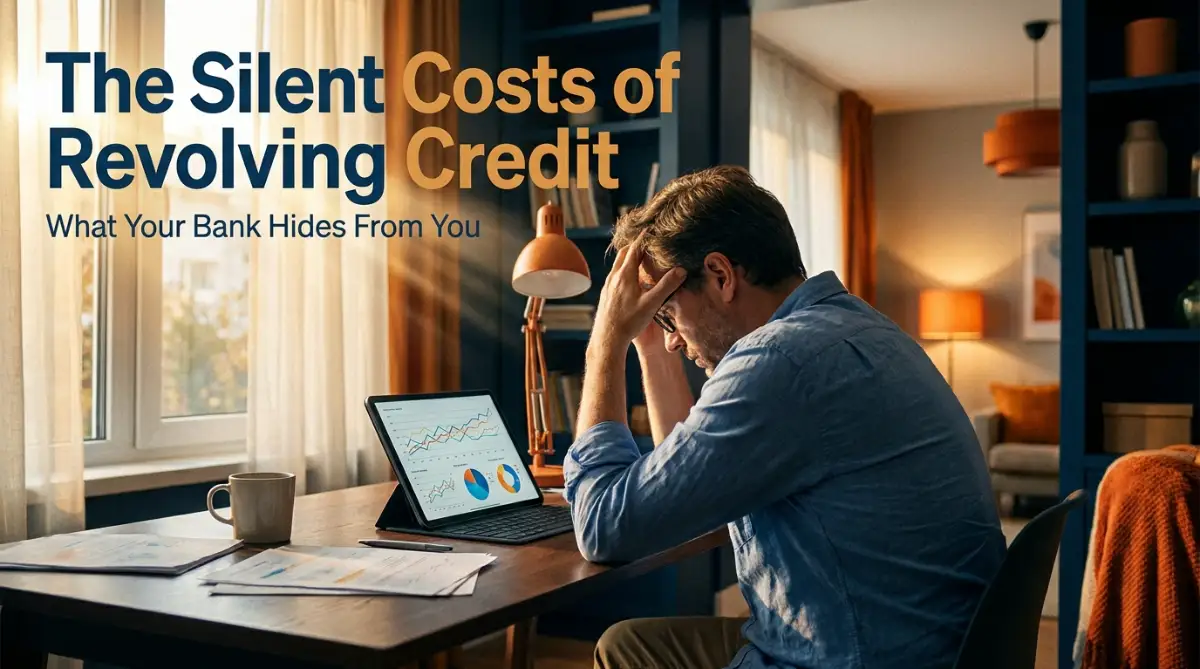
How an 'Innocent' Credit Line Quietly Drained My Peace of Mind
Let's talk about that sick feeling in your stomach when you check your bank app. You make your payments on time, skip the expensive coffees, and try your best to be responsible with your money. Yet, your credit line balance barely moves. I spent months paying the "minimum due," totally unaware that a hidden mathematical trap was quietly eating my cash. Let me show you exactly how this banking system is rigged and the simple steps you can take today to stop the bleeding.
I was using a revolving credit line for emergencies and paying just enough every month to keep the bank completely happy.
But that afternoon, sitting at my kitchen table with a cup of cold coffee, reality hit me like a ton of bricks.
The main balance had barely gone down at all, even though I was making those automated payments every single month without fail.
It felt like I was pouring my hard-earned money into a bottomless black hole that kept demanding more.
Every time I looked at my phone and saw a notification from my banking app, a wave of anxiety washed over me.
I realized that this so-called helpful financial tool was actually a heavy chain wrapped tightly around my daily life.
Millions of normal, hardworking people wake up to this exact same nightmare every single morning.
Yet, no matter how hard you push forward, that invisible mountain of debt just keeps growing silently in the background.
It steals your focus during important family dinners and keeps you staring at the ceiling at two in the morning.
We often blame ourselves for not working hard enough, but the real enemy is a system designed to keep us trapped.
You deserve to sleep peacefully at night without mentally calculating how much interest you are going to be charged tomorrow.
Today, I am going to share exactly how these hidden traps work and how you can finally break completely free.
🛑 Stop the Debt Cycle: Your Quick Action Plan
- Never pay just the minimum: The minimum payment is mathematically designed to keep you in debt for years. Always pay more.
- Beat the daily interest: Split your monthly payment in half and pay every two weeks to lower your average daily balance.
- Pay before the statement date: Pay down your balance a few days before your statement closes to artificially boost your credit score.
- Hide the plastic: Put your active credit cards in a drawer or a block of ice so you are forced to spend cash only.
Peeling Back the Curtain: What Your Bank Hides in the Fine Print
If you want to stop losing your hard-earned money, you need to understand exactly how the game is played against you.
Banks and financial institutions use incredibly clever math and confusing terms to make bad deals look highly attractive.
Let us look closely at the invisible mechanics of your revolving credit account and expose the traps waiting for you.
The Illusion of the Minimum Payment Requirement
One of the biggest financial traps you will ever face is the minimum payment option on your monthly statement.
When you see that small, affordable number at the bottom of your bill, your brain naturally feels a sense of relief.
You think to yourself that paying this tiny amount is a highly responsible way to manage your current cash flow.
However, this small number is actually a carefully calculated mathematical trick designed to maximize the bank's profit.
When you only pay the minimum, you are mostly just covering the interest that was generated over the last thirty days.
Very little of your payment actually goes toward reducing the original amount of money you borrowed in the first place.
Let me give you a highly realistic scenario.
Imagine you bought a beautiful new refrigerator for your kitchen using your shiny new credit line.
If you only make the minimum payments, that same refrigerator could easily end up costing you three times its original price.
You will literally still be paying for that appliance long after it has broken down and been thrown in the trash.
This is how financial institutions build massive skyscrapers while everyday people struggle to buy basic groceries.
Do you want to stop bleeding money?
The Shocking Math: Minimum Payments vs. Fixed Payments
Let's pretend you have a $5,000 balance with a 20% interest rate. Look at how much money the bank steals from you if you only pay the minimum:
| Payment Strategy | Monthly Payment | Time to Pay Off | Total Interest Paid to Bank |
| :--- | :--- | :--- | :--- |
| The Minimum Trap | Usually around 100∣∗∗Over9Years!∗∗∣∗∗
100∣∗∗Over9Years!∗∗∣∗∗
4,300+** |
| The Smart Way | Fixed at $250 | Just 2 Years | Only $1,100 |
Lesson: Finding just an extra $150 a month saves you over three thousand dollars and buys back seven years of your life.
[Bold Intro Text]: Are you tired of feeling confused about how minimum payments secretly keep you trapped in a never-ending cycle of debt? Watch this incredibly simple breakdown that exposes the hidden math your bank uses against you!
The Daily Compound Interest Trap
We often think of interest as a simple, yearly fee that we pay for the privilege of borrowing money.
Unfortunately, revolving credit accounts usually calculate your interest on a daily basis, which completely changes the math.
Every single day you carry a balance, a tiny amount of interest is silently added to your total debt.
The very next day, you are charged interest on the original amount plus the interest from the day before.
It is like a snowball rolling down a massive hill, getting bigger and faster with every single rotation.
This daily compounding effect means that your debt grows much faster than your human brain can naturally calculate.
You might think you owe a specific amount, but the reality is quietly changing every time the sun goes down.
To fight this, you must completely change the way you look at your account balances and your payment schedules.
I learned this lesson the hard way after watching my balance stay exactly the same for nearly six months.
I was making payments, but the daily interest was eating up my money faster than I could send it in.
My Personal Realization (Pro Tip): For a long time, I waited until the very last day of the billing cycle to make my single monthly payment. I quickly realized that paying half of my bill every two weeks drastically reduced my average daily balance. By simply splitting my payments into smaller chunks, I stopped the daily interest from growing so aggressively and finally started seeing my balance drop.

The Secret Damage to Your Credit Score
Most people believe that as long as they make their monthly payments on time, their credit score will remain excellent.
While paying on time is definitely important, there is another silent factor that banks use to judge your financial health.
This highly sensitive factor is known as your credit utilization ratio, and it can quietly destroy your borrowing power.
Your utilization ratio is simply the amount of money you currently owe compared to your total available credit limit.
If you have a credit limit of a certain amount and you use most of it, the credit bureaus immediately get nervous.
Even if you never miss a single payment, holding a high balance makes you look like a highly risky borrower.
When your utilization ratio goes up, your credit score automatically starts dropping without any warning.
A lower credit score means you will be forced to pay much higher interest rates if you ever need a car loan or a mortgage.
You might end up paying thousands of extra dollars for a family home simply because your revolving credit line was maxed out.
To protect your financial reputation, you should always try to keep your borrowed amount below thirty percent of your total limit.
This simple habit sends a strong signal to lenders that you are a highly responsible and trustworthy person.
The Nightmare of Floating Interest Rates
When you originally sign up for a revolving credit line, the bank often highlights a very attractive, low introductory interest rate.
They use big, bold letters in their advertising to make you feel like you are getting the deal of a lifetime.
What they hide in the tiny print is the fact that this specific rate is usually variable, meaning it can change at any time.
When the national economy shifts and central banks raise their numbers, your personal interest rate silently goes up too.
You could wake up one morning and find out that borrowing the exact same money now costs you significantly more.
You do not get to vote on this change, and the bank does not need your permission to increase your monthly burden.
If you have a large balance when the rates suddenly jump, your minimum payment might suddenly become completely unaffordable.
This unpredictability makes it nearly impossible to create a reliable monthly budget for your household expenses.
You are constantly playing a dangerous game of financial roulette where the bank always holds the winning cards.

Myth vs Reality: Breaking the Misconceptions
To truly protect yourself, we need to completely shatter some of the most common lies people believe about borrowing money.
Many of these dangerous myths are passed down from friends, family members, or extremely clever marketing campaigns.
When you finally stop believing these common myths, you instantly take back control of your own financial destiny.
You stop playing by the rules created by people who profit directly from your continued financial struggles.
The Hidden Cost of Lost Opportunities
We often measure the cost of debt just by looking at the specific dollar amount we pay in monthly interest.
However, the real tragedy of a revolving credit trap is all the incredible things you cannot do with your money.
Every single dollar you send to the bank to cover interest is a dollar stolen directly from your future.
Think about the amazing family vacations you could have taken if you had kept that extra money in your own pocket.
Imagine how much faster you could have built a comfortable retirement fund or paid for your children's higher education.
When your income is constantly tied up in debt payments, you completely lose the ability to invest in yourself.
You miss out on starting a small side business because you are too afraid of taking any additional financial risks.
This lost opportunity cost is completely invisible, but it is the most damaging part of the entire revolving credit system.
You are essentially financing the bank's future while heavily sacrificing the comfort and security of your own family.
Reclaiming Your Financial Power Today
The very first step to fixing this massive problem is to completely stop digging the hole any deeper.
You need to take all of your cards and put them in a place where they are extremely difficult to access daily.
If you do not have immediate access to the borrowed funds, you will naturally stop spending money out of pure habit.
Next, you need to sit down and face the absolute reality of the numbers printed on your monthly statements.
Look at exactly how much interest you are paying and let that totally unacceptable number make you truly angry.
Use that intense emotional frustration to completely change the way you handle your daily spending habits.
Start cutting out small, unnecessary expenses and send every single extra dollar directly toward your highest interest balance.
It will definitely not be easy, and it will absolutely require a strong level of personal discipline over the coming months.
But I promise you that the feeling of checking an account balance and seeing a perfect zero is completely priceless.
You will finally breathe easier, sleep better, and instantly regain total control over your entire financial world.
Instead of working hard to make a massive banking institution rich, you will finally start building wealth for your own future.
Next-Level Strategies to Beat the Bank at Their Own Game
Now that you clearly understand how the banking system quietly drains your pockets, it is time to fight back.
You do not need to be a Wall Street banker or a math genius to completely turn this situation around.
You just need to learn a few incredibly smart, advanced strategies that instantly shift the power back into your hands.
These are the exact same secrets that financially independent people use to protect their hard-earned money every single day.
Let us break down a few highly effective moves you can start using this afternoon to stop the bleeding.
The Magic of the Statement Date Trick
Most people only focus on the final due date printed in bold letters on their monthly bank statement.
They schedule their single payment for that exact day, thinking they are being highly responsible and organized.
What they do not realize is that the bank reports your current balance to the credit bureaus a few weeks before that due date.
This specific day is called your statement closing date, and it is entirely separate from your actual payment deadline.
If you wait until the due date to pay, the credit bureaus see a massive balance, which instantly drops your score.
The pro-secret here is to completely pay down your balance three days before the statement closing date even happens.
By doing this, your reported balance shows up as zero, making you look like an absolute superstar to lenders.
This simple timing adjustment completely protects your financial reputation without requiring you to spend an extra penny.
You can easily learn more about how credit reporting agencies track these dates by checking the official guidelines provided by the Consumer Financial Protection Bureau.
The Daily Micro-Payment Strategy
We talked earlier about how daily compound interest silently adds a new layer of debt to your account every twenty-four hours.
If you make just one large payment at the end of the month, the bank gets thirty full days to charge you interest.
You can completely disrupt this greedy mathematical formula by switching to a daily or weekly micro-payment schedule.
Instead of sending three hundred dollars at the end of the month, try sending ten dollars every single morning.
Because your overall balance is dropping slightly every single day, the daily interest charge gets smaller and smaller.
By the end of the month, you will have paid significantly less interest just by changing the timing of your money transfers.
It takes less than two minutes a day on your banking app, but it easily saves you thousands of dollars over time.
Utilizing Strategic Balance Transfers Safely
Sometimes, the interest rate on your current revolving account is simply too high to make any real progress.
In these specific situations, moving your current debt to a new account with a zero percent promotional rate can save your life.
However, you must be extremely careful, as this is exactly where many desperate people make things much worse.
Before you move any of your balances around, you need to know exactly how debt consolidation affects your credit score over the long run.
A balance transfer can give you a twelve-month breathing period where zero interest is added to your account.
You must use this quiet period to aggressively pay down the main balance before the promotional rate completely expires.
If you fail to clear the debt before the deadline, you will get hit with a massive wave of deferred interest charges.
The Dangerous Financial Traps We All Walk Into
Fixing your financial life is just as much about avoiding bad decisions as it is about making good ones.
When people get highly motivated to escape the debt cycle, they often rush into terrible choices out of pure panic.
The banks actually rely on this panic and set up very clever traps to catch you when you are vulnerable.
Let us look closely at the most destructive mistakes you must entirely avoid on your journey to freedom.
The Balance Transfer Shuffle Illusion
Moving debt from one account to another often feels exactly like you are making real financial progress.
You see a brand new account with a zero balance, and your brain suddenly releases a massive rush of relief.
The harsh reality is that you did not actually pay off anything; you simply moved the heavy furniture to a different room.
The biggest pitfall here is that people often keep their old, empty credit line completely open and accessible.
Because they feel so relieved, they eventually start using that old account again for minor daily expenses.
Within a few months, they now have two maxed-out credit lines instead of just one, completely doubling their financial stress.
My "Safe Transfer" Checklist
Thinking about moving your debt to a 0% interest card? Run through this checklist before you hit submit:
- Did I calculate the 3-5% hidden transfer fee?
- Do I have a strict plan to pay off the balance before the 12-month promo ends?
- Have I hidden or frozen the old credit card so I do not use it again?
- If you cannot check all three boxes, do not move the money.
The Federal Trade Commission constantly warns consumers about the hidden fees completely buried in these attractive balance transfer offers.
You usually have to pay a flat fee of three to five percent just to move your money, which instantly adds to your burden.
Treating Available Credit as Cash in the Bank
One of the most dangerous psychological tricks our minds play on us is looking at a credit limit as actual wealth.
When you see an available balance of ten thousand dollars on your screen, it naturally makes you feel financially secure.
You start making riskier decisions, assuming that this invisible safety net will always be there to catch you if you fall.
You might decide to completely ignore your savings account because you assume the bank has your back in an emergency.
This false sense of security is absolutely devastating when a real-life crisis suddenly hits your family.
If the economy crashes, banks can and will lower your credit limit to zero without giving you any prior warning.
You will be left with no emergency cash, no available credit, and a massive mountain of high-interest debt to climb.
Instead of relying on borrowed funds, you should actively try to build a brand on a tight budget or start a small side income to build real cash reserves.
The Emotional Toll of Impulse Account Closures
There is an incredibly satisfying feeling that comes with making the final payment on a massive debt.
Many people get so angry at the bank that they immediately call customer service and close the account forever.
While this definitely feels great at the moment, it is actually one of the worst things you can do to your credit profile.
A huge part of your financial reputation is based on the average age of your active open accounts.
When you quickly close your oldest credit line, you instantly erase years of positive payment history from your record.
Additionally, closing an account immediately shrinks your total available credit, which instantly spikes your utilization ratio.
Even though you just paid off a huge debt, your credit score will randomly drop like a rock the very next week.
Just as businesses use specific metrics to measure their overall performance, credit bureaus use these account details to measure your reliability.
Instead of closing the account, just cut the physical plastic card into tiny pieces and delete the saved numbers from your phone.
Your Personal Blueprint for Total Financial Peace
Breaking free from the invisible chains of revolving credit is not something that happens entirely overnight.
It requires a massive shift in how you view your daily spending, your future goals, and your relationship with money.
The banking system is incredibly smart, but now you have the exact knowledge needed to outsmart them at every single turn.
You are no longer a blind passenger on this ride; you are completely in the driver's seat of your financial destiny.
Think of your personal finances exactly like running a highly successful, fast-growing startup company from your living room.
Just as remote teams rely on specific agile methodologies to adapt to sudden changes, you must stay completely flexible with your money.
If you face an unexpected car repair or a medical bill, do not panic and give up on your entire plan.
Simply adjust your budget, handle the immediate emergency, and get right back to attacking your highest interest balances.
Having a strong, organized strategy is exactly why big corporations use proven project management frameworks to guarantee their long-term success.
You deserve to treat your own family's wealth with that exact same level of professional respect and careful planning.
According to experts at the National Endowment for Financial Education, simply tracking your spending habits increases your chances of becoming debt-free by over sixty percent.
You just need to take that very first step today, no matter how small or completely insignificant it might feel.
My Final Note to You: I remember the heavy weight on my chest when I thought I would never escape my own debt cycle. Today, I am entirely free, and I want you to know that you absolutely have the strength to do this too. Start small, forgive yourself for past mistakes, and promise yourself that your financial future officially changes today.
Common Questions About Escaping Credit Line Debt
Does keeping a small balance open help build my credit score faster?
No, this is a very popular myth created to make banks more money off everyday consumers. You do not need to pay a single penny in interest to build a great credit profile. Paying your entire balance off in full every month is always the best way to improve your overall score.
Can the bank legally lower my limit without telling me first?
Yes, financial institutions have the legal right to reduce your available limit at almost any time they choose. This usually happens during tough economic times or if they suddenly view you as a higher risk. This is why you should never treat an open credit line as a reliable emergency cash fund.
How do I stop daily interest charges from growing so quickly?
The absolute best way to slow down daily interest is to make multiple payments throughout the entire month. By paying half your bill every two weeks, your average daily balance drops significantly. This simple timing trick forces the bank to calculate their interest on a much smaller number.
Should I prioritize paying off the biggest balance or the highest interest rate?
Mathematically, you will always save the most money by attacking the account with the highest interest rate first. However, paying off a tiny balance quickly can give you a massive psychological boost of motivation. Pick the method that keeps you excited and completely focused on the final goal.
What happens if I accidentally miss just one minimum payment?
Missing a single payment can immediately trigger massive penalty fees and completely erase your low promotional interest rates. If it goes thirty days past due, it gets reported to the bureaus and heavily damages your credit score. Always set up automatic minimum payments as a backup safety net, even if you plan to pay more manually.
Disclaimer: The information provided in this blog post is completely for educational and informational purposes only and should not be considered professional financial advice. Every individual's financial situation is highly unique. Always consult with a certified financial planner or advisor before making any major decisions regarding debt consolidation, investments, or personal credit management.

![7 Hidden Ways Mandatory Forbearance Destroys Your Credit [Avoid These Mistakes]](https://vimex24.com/storage/uploads/blogs/1788962201_7-hidden-ways-mandatory-forbearance-destroys-your-credit-avoid-these-mistakes.webp)