
The Silent Cash Flow Killer Destroying Good Businesses
Stop me if you have heard this one before: your sales are blowing up, your phone won't stop buzzing with new order alerts, but your bank account is somehow empty. I learned the hard way that high revenue means absolutely nothing if your ads are eating all your profit. Let's fix your math before your marketing budget bankrupts you.
This is a painful trap that so many passionate business owners fall into every single day. You see the revenue numbers going up, and it gives you a false sense of absolute security. But behind those big revenue numbers, the actual profit margins are bleeding out because the marketing expenses are completely out of control.
The stress of this situation bleeds into your everyday life and ruins your mental peace. You find yourself waking up in the middle of the night just to check your ad manager dashboard. You start wondering if you need to take out another loan just to keep the ads running.
This anxiety happens because most founders are flying blind when it comes to the numbers that actually matter. They throw hard-earned money at marketing agencies and cross their fingers, hoping the math somehow works out at the end of the month. It feels like you are pouring water into a bucket that has massive holes at the bottom.
The truth is, focusing only on top-line revenue is a very dangerous game to play. You end up working 80 hours a week, dealing with customer complaints and managing inventory, only to realize you are basically working for free. Your mental health suffers because you never feel secure about the financial future of your dream project.
I finally realized that I could not keep running my business on hope and guesswork anymore. I needed to understand the exact math behind every single dollar that left my bank account. I needed to know exactly what a customer was worth to me over their entire lifetime, not just on their very first purchase.

Before You Read Further (Quick Takeaways):
- Your true marketing cost includes software, freelancer fees, and discounts, not just your daily ad budget.
- A healthy business aims for a 3:1 ratio (you make three times more from a buyer than it cost to get them).
- Stop relying on massive discounts; they train your audience to never pay full price.
- Customer retention is cheaper and way more profitable than chasing new clicks every day.
Cracking the Code Behind True Profitability
If you want to stop losing sleep over your ad spend, you need to master the numbers that dictate your success. We are going to break down these concepts so simply that you can apply them to your business this afternoon. You do not need a finance degree to understand this stuff.
Let us start by looking closely at how you actually buy a customer. Yes, in business, you are essentially buying customers.
Understanding the True Cost of Buying a Customer
The money you spend to get someone to buy from you is known as the Customer Acquisition Cost. Most people think this is just the money they give to Facebook or Google for ads. But that is a very dangerous assumption that leads to terrible financial decisions.
Your true acquisition cost includes absolutely everything involved in the marketing and sales process. It includes the ad spend, the money you pay to your marketing freelancer, the cost of your email software, and even the discounts you offer to first-time buyers.
If you spend $1000 on total marketing efforts in a month and you get 10 new customers, your acquisition cost is $100. You essentially paid $100 to acquire each person.
Now, if you are selling a product that only gives you $50 in profit, you are losing money on every single sale. This is exactly how companies go bankrupt while showing massive sales numbers. They are paying more to acquire the customer than the customer is actually spending.
I used to calculate my acquisition cost just by looking at my ad dashboard, totally ignoring the thousands of dollars I paid my graphic designer and copywriter. My real cost per customer was nearly double what I thought it was, and fixing that one simple calculation saved my entire business from going under.
Discoere is a quick checklist of the hidden marketing costs you might be ignoring right now:
vering the Hidden Value of Your Buyers
This brings us to the second, and arguably more exciting, part of the math equation. We need to figure out exactly how much a single customer is worth to your business over the long run. This is known as Customer Lifetime Value.
Most beginners only look at the very first order a person places. If someone buys a $50 shirt, the business owner thinks that customer is worth $50. But what if that same person loves the shirt so much that they come back and buy five more shirts over the next two years?
Suddenly, that single customer is not just worth $50 anymore. They are worth $300 to your business. This completely changes the way you can spend money to acquire them in the first place.
Watch This Quick Breakdown to Master Your Numbers
If you are a visual learner, this simple video explains the exact connection between your marketing costs and long-term customer value in plain English.
[Insert YouTube Video Link Here]
When you know that a customer will spend $300 with you over time, spending $100 to acquire them suddenly seems like a brilliant investment. You are essentially trading a $100 bill today for $300 over the next few years.
This is the exact secret that allows massive brands to outspend their small competitors. They know their long-term value is high, so they can afford to pay more for that initial click.
The Golden Ratio of Business Health
Now that we have both of these numbers, we need to compare them to see if your business is actually healthy. You do this by looking at the relationship between the lifetime value and the acquisition cost.
Experts generally agree that a very healthy business has a ratio of 3 to 1. This means you make three times more from a customer than it cost you to acquire them.
Let me show you a quick breakdown of how different ratios tell a different story about a business:
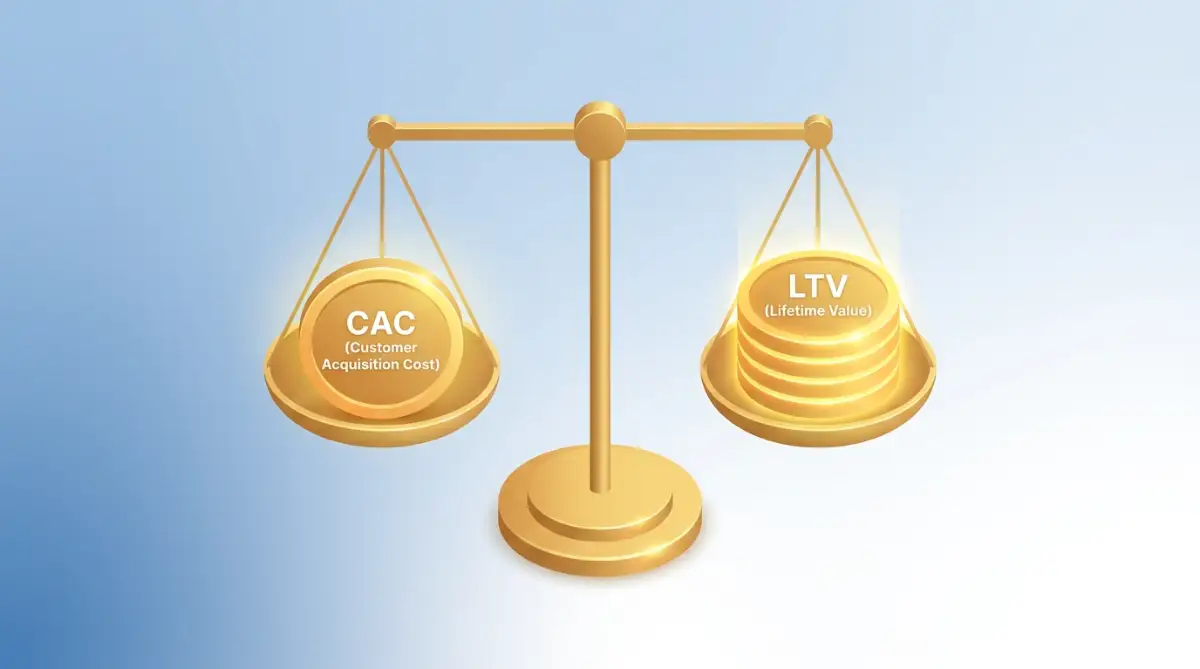
If your ratio is 1 to 1, you are essentially trading dollars and doing a lot of free work. You need to either raise your prices, get people to buy more often, or find cheaper ways to market your products.
On the other hand, if your ratio is 5 to 1, you might be playing it too safe. You are highly profitable, but you could easily afford to spend more on marketing to grow your business much faster. Finding that sweet spot is the key to sustainable growth.
Real-Life Scenario: The Coffee Subscription
Let us look at a practical example to make this completely crystal clear. Imagine you run a business that delivers premium coffee beans to people every single month.
Your monthly subscription costs $20. The actual coffee and shipping cost you $10. This means you make $10 in pure profit every single month from a subscriber.
If you spend $30 on ads to get a new subscriber, you are in the negative on day one. You paid $30, but you only made $10 in profit. A beginner would panic and turn off the ads immediately.
But you are smarter than that now. You look at your data and see that the average customer stays subscribed for 12 months. That means they will generate $120 in profit for you over a year.
Now the math looks beautiful. You spent $30 to acquire them, and they are bringing you $120 in profit. Your ratio is 4 to 1. This is a highly profitable coffee business, even though it looked like a failure on the very first day.
Myth vs Reality: The Advertising Trap
The Myth: A successful business always has cheap advertising costs. You should constantly try to find the cheapest clicks possible.
The Reality: The most successful businesses actually have high acquisition costs because they target premium customers. They focus on increasing the lifetime value so they can afford to buy the most expensive, highest-quality traffic on the internet.
This changes your entire perspective on marketing. Instead of fighting for penny-clicks from people who will never buy, you can confidently invest in high-quality ads. You know that even if the first sale is expensive, the long-term relationship will pay off massively.
How to Naturally Boost Your Customer Value
If you want to improve your ratio, you do not always have to cut your marketing budget. In fact, the easiest way to become more profitable is to simply get your current buyers to spend more money with you.
Think about the last time you bought a camera. You did not just buy the camera body. You probably bought a memory card, a carrying case, and maybe an extra battery. The store increased your value by offering relevant products right at the checkout.
You can do this in your own business through simple upsells. If someone is buying a physical product from your store, offer them a discounted complementary item right before they pay. It costs you absolutely nothing in marketing to make that second sale.
Another powerful method is to focus heavily on an amazing customer experience. People return to brands that treat them like human beings. If you answer support emails quickly and resolve issues with a smile, people will naturally come back to you.
Customer retention is the ultimate secret weapon for profitability. It is always much cheaper to keep an existing customer happy than it is to go out and convince a complete stranger to trust you. Building loyalty should be your main priority every single day.
Beyond the Basics: Pro-Level Growth Strategies
Now that you understand the basic math behind your marketing expenses, we need to talk about scaling. Getting your first few profitable buyers is a great feeling, but keeping that momentum going requires a different set of skills. You cannot just rely on basic math forever if you want to build a truly massive brand.
I learned very quickly that the most successful founders do not just look at their numbers once a month. They actively shape those numbers every single day using very specific psychological triggers. They build systems that naturally encourage people to spend more money without feeling pressured.
Let us look at some highly effective strategies that you can start using today. These are the exact methods smart marketers use to stretch their advertising budgets further than anyone else.
The Power of the Payback Period
Most beginners focus entirely on how much they spend and how much they eventually make. But they completely ignore the timeline. Knowing your numbers is great, but knowing exactly when you get your money back is what actually keeps your doors open.
Think about this scenario for a moment: Let us say you spend $100 to get a customer, and they are worth $300 to you over three years. That is a fantastic ratio. But what if they only spend $20 on their first purchase, and it takes two whole years for them to spend the rest?
You will run out of cash extremely fast. You are fronting $100 today to slowly earn it back over 24 months. This is exactly why amazing businesses go bankrupt. They simply run out of working capital while waiting for their buyers to return.
Your goal must be to shorten that payback period as much as possible. You want to earn back that initial $100 within the first thirty days, or even better, on day one. When you get your money back instantly, you can reinvest it into new ads the very next morning.
Creating Zero-Cost High-Margin Add-Ons
One of the easiest ways to shorten your payback period is to offer something that costs you almost nothing to deliver. Physical products have high shipping costs and manufacturing fees. But digital products are pure profit.
For example, if you sell workout equipment, you could easily package a 30-day digital workout guide. If you manage to create your first digital product and sell it fast alongside your physical gear, your average order value instantly shoots up.
You pay the same amount to acquire the customer, but they spend an extra $20 on your digital guide at checkout. Because there are no shipping fees for a PDF file, that $20 goes straight to your bottom line. This instantly covers a large chunk of your initial marketing expense.
Identifying Your "Whale" Customers
Not all buyers are created equal. This is a hard truth that took me a long time to accept. When you look closely at understanding customer lifetime value models, you will notice a fascinating pattern.
Usually, about 20% of your buyers will generate 80% of your long-term profits. These are your "whales". They love your brand, they buy every new product you launch, and they tell their friends about you.
Instead of trying to treat everyone exactly the same, you need to identify who these heavy spenders are. Look at your past sales data. What do these specific people have in common? Where do they live? What specific ads did they click on originally?
Once you figure out the exact profile of your best buyers, you can tell your ad platforms to only look for people just like them. You might pay a little more for the initial click, but the long-term payoff will be absolutely massive.
Building an Organic Referral Engine
Paid advertising is amazing for fast growth, but word-of-mouth marketing is what builds lasting empires. If you can get your current buyers to bring you new ones, your average acquisition cost drops dramatically.
Think about building organic referral programs as a way to print free money for your marketing budget. If someone loves your product, give them a special discount code to share with their friends.
When their friend uses the code, both the new buyer and the original customer get a small reward. You just acquired a brand new paying customer without spending a single dime on Facebook or Google ads. This naturally pulls down your overall marketing expenses across the board.
Myth vs. Fact: Referral Programs
Myth: You have to give away huge cash rewards to get people to share your brand.
Fact: Sometimes, exclusive access works better than money. Giving your best buyers early access to a new product release in exchange for a shoutout is practically free for you, but feels like VIP treatment to them.

The Hidden Traps That Quietly Drain Your Bank Account
Even with the best strategies in place, it is incredibly easy to make simple mistakes that ruin your profit margins. I have personally made almost every mistake on this list, and they cost me thousands of dollars in lost revenue.
Let us walk through the most dangerous pitfalls so you can protect your hard-earned money. Avoiding these errors is just as important as finding new ways to grow.
Trap 1: The Blended Cost Illusion

This is probably the most common way business owners lie to themselves. When you look at your total marketing spend, you might see that you spent $1000 and got 100 new buyers. You happily calculate that you are paying $10 per person.
But this "blended" number hides the ugly truth. Maybe 80 of those buyers came from organic search traffic, which is totally free. That means your $1000 ad campaign actually only brought in 20 people.
Suddenly, your real cost for paid traffic is $50 per person, not $10. If you do not separate your free organic traffic from your paid traffic, you will blindly throw money into failing ad campaigns. Always measure the specific cost of each individual marketing channel.
Trap 2: The Discount Death Spiral
When sales are slow, the natural human reaction is to offer a massive discount. You blast out a 40% off coupon just to get some cash flowing into the business. While this works immediately, it quietly destroys your brand over the long run.
When you constantly run massive sales, you train your audience to never pay full price. They will simply wait for your next holiday promotion. Even worse, heavy discounts attract bargain hunters who have absolutely no long-term loyalty to your company.
These cheap buyers will ruin your numbers. They cost just as much to acquire, but they will never return for a second purchase. If you want to build a premium brand, you must protect your pricing and focus on adding more value, rather than slashing your prices.
Trap 3: Ignoring the Silent Killer of Churn
Imagine trying to fill up a bucket with a giant hole at the bottom. No matter how much water you pour in, the bucket will never stay full. In the business world, that hole is called customer churn.
Churn happens when people stop buying from you or cancel their subscriptions. Research heavily highlights the impact of high customer churn rates on long-term sustainability. If you lose buyers faster than you gain them, your business is slowly dying.
The exact same thing applies to your buyers. If they are dropping off after the first month, you need to find out exactly why. Is your product quality dropping? Is your customer service ignoring their emails? Fix the hole in the bucket before you spend another dollar on ads.
Trap 4: Running Out of Personal Energy
Building a business is an emotional rollercoaster. When your ad costs spike unexpectedly, it is very easy to panic and make terrible emotional decisions. You might decide to just shut everything down because the stress becomes too heavy to carry.
Just like understanding the science of phone batteries and how to make yours last for years, you need to manage your own personal energy reserves. You cannot run at 100% capacity forever without burning out completely
Your Step-by-Step Blueprint for Immediate Profitability
We have covered a lot of deep concepts today, from understanding your baseline numbers to avoiding dangerous financial traps. But knowledge is completely useless unless you actually apply it to your daily routine.
You do not need to change your entire business model overnight. Big changes usually cause unnecessary chaos. Instead, focus on making small, calculated adjustments to your marketing strategy every single week.
Your Action Plan for Tomorrow Morning
1. Audit Your Current Spending:
Wake up tomorrow and pull up your bank statements. Write down every single tool, freelancer, and ad platform you pay for. Calculate your true, honest acquisition cost without hiding any hidden fees.
2. Map Out The Buyer Journey:
Look at the last 50 people who bought from you. How many of them came back a second time? Calculate your current average lifetime value based on real historical data, not just optimistic guesses.
3. Implement One Upsell:
Find a way to add an extra complementary item to your checkout process this week. Make it something simple and irresistible. Watch how this tiny change immediately improves your profit margins on day one.
4. Email Your Best Buyers:
Find the top 10 people who have spent the most money with you this year. Send them a personal, plain-text email simply thanking them for their support. Do not try to sell them anything. Just build a real human connection.
By taking these small steps, you shift from being a reactive business owner to a proactive strategist. You take back control of your cash flow and secure your financial future.
I spent years operating in a constant state of financial anxiety because I was terrified of digging into my spreadsheets. But the moment I finally faced the math and understood my true costs, everything changed for the better. The numbers are not there to scare you; they are there to guide you toward real, lasting freedom. Take a deep breath, trust the math, and start building the profitable business you truly deserve.
Common Questions About Managing Marketing Costs
How often should I calculate these metrics?
You should ideally look at your numbers on a weekly basis to catch any sudden spikes in your ad costs. However, a deep, thorough analysis of your long-term buyer value should be done at the end of every month. This keeps you agile without overwhelming you with daily data changes.
Does this math apply to a brand-new business?
Absolutely. Even if you only have five paying buyers, you need to understand exactly what it cost to get them. Tracking your numbers from day one prevents you from developing terrible spending habits as your brand grows.
What if my product is a one-time purchase?
If you sell something people only buy once, like a heavy piece of furniture, your lifetime value will naturally be lower. In this case, you must maintain a very low initial acquisition cost, or start offering complementary products like cleaning kits to generate repeat sales.
Should I hire a professional agency to track this?
In the beginning, you should absolutely track these numbers yourself so you understand the heartbeat of your company. Once you are generating consistent, high-volume profit, you can hire a data expert to handle the complex reporting for you.
Why did my advertising costs suddenly double overnight?
Ad platforms operate on an auction system, meaning costs naturally fluctuate based on market competition and seasonal trends. If your costs spike, pause your lowest-performing ads immediately and focus entirely on nurturing the people who have already bought from you.
Disclaimer: The information provided in this article is for educational and informational purposes only and does not constitute financial or professional business advice. Marketing costs and profit margins vary greatly depending on your specific industry, location, and economic factors. Always consult with a certified financial advisor or business professional before making significant changes to your advertising budgets or pricing structures.

![7 Proven Steps to Secure Your First Seed Funding [Step-by-Step]](https://vimex24.com/storage/uploads/blogs/1786243058_7-proven-steps-to-secure-your-first-seed-funding-step-by-step.webp)
![7 Proven Agile Methodologies to Skyrocket Remote Startup Growth [Step-by-Step]](https://vimex24.com/storage/uploads/blogs/1786212322_7-proven-agile-methodologies-to-skyrocket-remote-startup-growth-step-by-step.webp)