The Hidden Struggle Behind Understanding Modern Technology
Ever felt like you are reading a foreign language when people talk about smart algorithms? You are definitely not alone. For a long time, I thought you needed an advanced math degree to figure out how software sorts our emails or suggests what video to watch next. The truth is, the tech industry hides very simple concepts behind big, scary buzzwords. Today, we are going to strip away that heavy jargon. I want to show you exactly how everyday software really works, using plain English that makes sense right away.
It was a deeply isolating feeling. I kept asking myself if I was simply not smart enough to grasp these new concepts. Every time I tried to read about neural networks, the explanations were packed with heavy mathematical terms that made absolutely no sense to me.
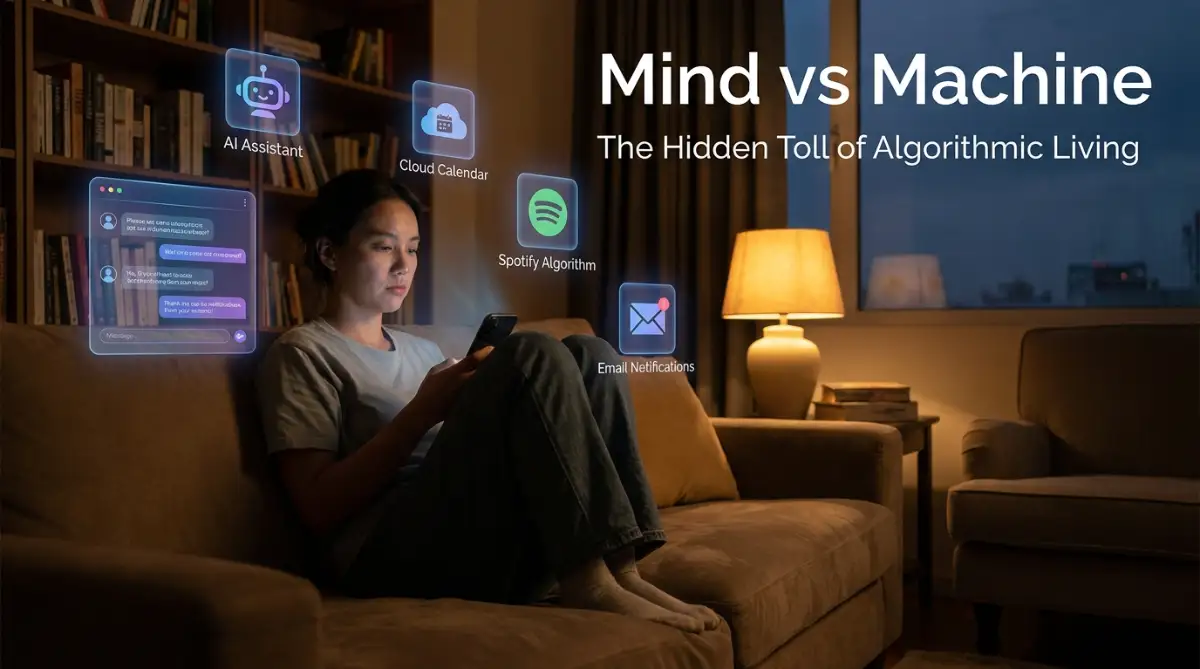
Regular people everywhere are facing this exact same frustration every single day. You wake up, open your smartphone, and suddenly everything is powered by smart algorithms. Social media feeds, video recommendations, and even your email spam filters seem to have a mind of their own.
This rapid shift leaves many of us feeling overwhelmed and confused. The mental peace we once had when using simple tools is gone. We constantly worry about falling behind in our careers or becoming irrelevant in a job market that demands tech skills.
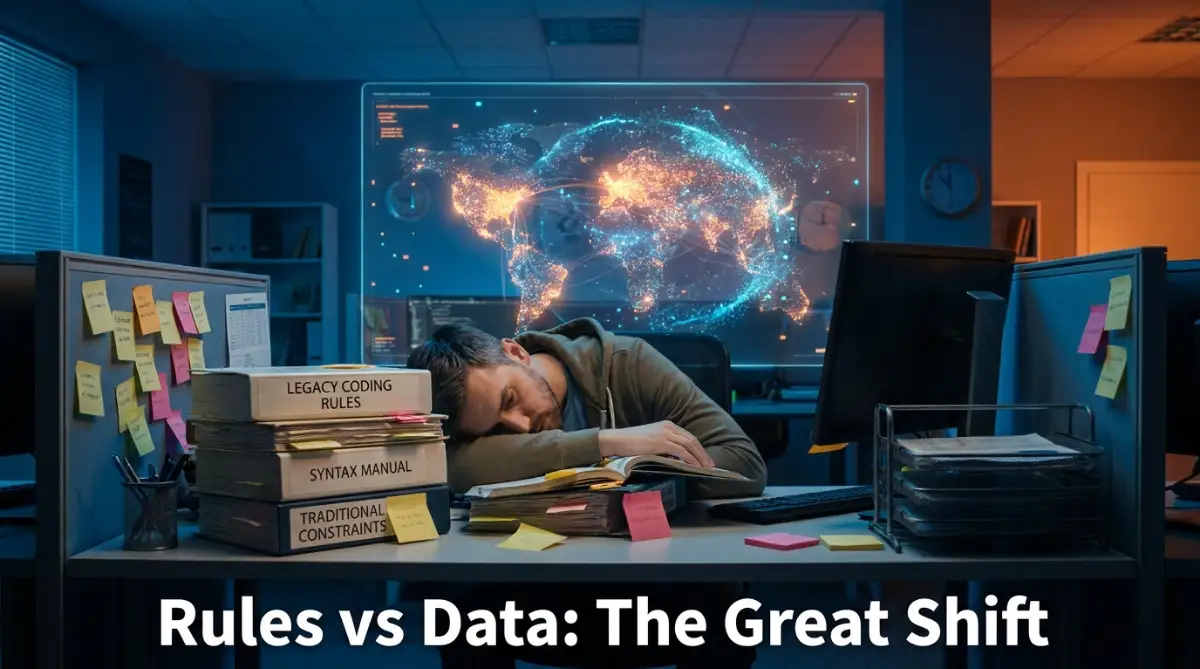
The reality is that nobody is born knowing this information. The tech industry has done a terrible job of explaining these concepts in plain English. They hide simple ideas behind big words to sound smarter.
But you do not have to accept this confusion anymore. Once you strip away the heavy terminology, the underlying logic is incredibly simple and highly fascinating. We are going to break down these barriers together, using language that makes perfect sense to anyone.
hat You Will Learn in 3 Minutes:
- The Big Shift: Why tech moved from humans writing strict rules to machines learning by example.
- How Models Think: The simple truth about neural networks and why they are just guessing games based on massive data.
- Your Next Steps: Practical ways to use data-driven tools in your daily work without feeling overwhelmed.
Unlocking the Logic: How Machines Actually Think Today
Breaking down this complex topic does not require a degree in computer science. All you need is a willingness to look at problem-solving from a slightly different angle. Let us explore exactly how old-school logic compares to modern machine thinking.
The Old School Approach: Writing the Rulebook
To truly appreciate the new methods, we first need to understand how we have been communicating with computers for decades. In traditional programming, humans are the absolute masters of logic.
Imagine you are baking a cake. You need a highly specific recipe to get the job done right. You need precise ingredients, exact measurements, and a strict sequence of steps.
In the software world, this recipe is created by a human developer. The programmer sits down and writes every single rule the computer must follow. They use a system of highly specific commands.
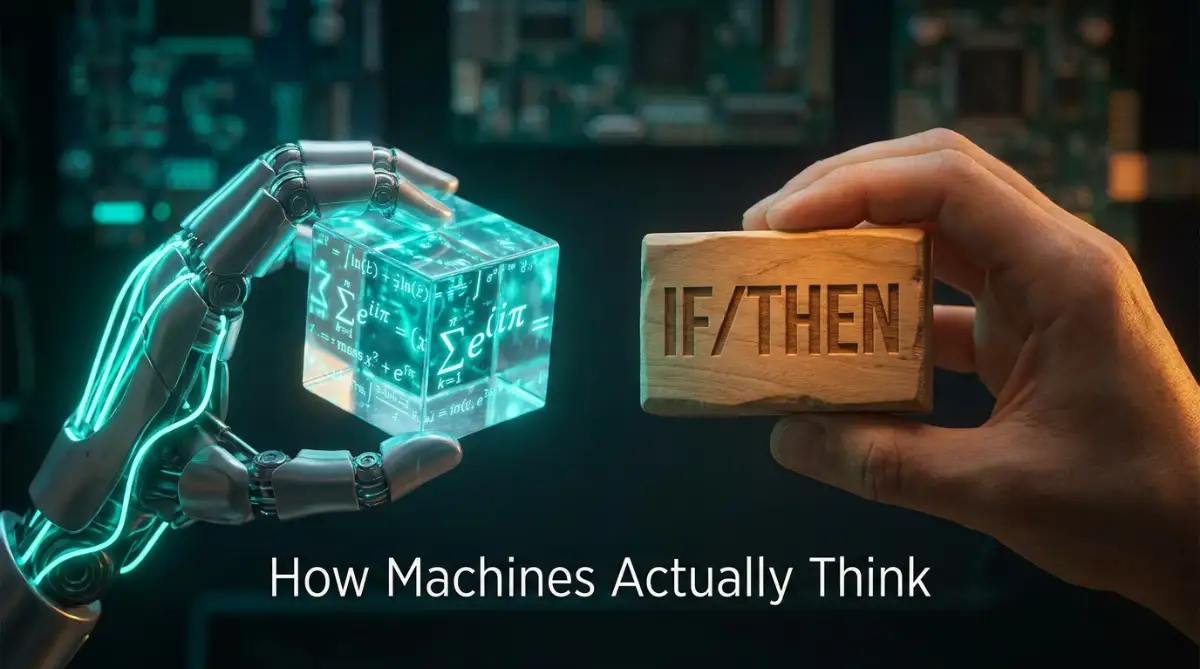
If this condition happens, then do this specific action. If the user clicks this button, then open this new window. This is known as rule-based logic.
The computer brings zero intelligence to the table. It is simply a very fast, very obedient machine that follows the recipe exactly as written. It never improvises, and it never learns from its mistakes.
Why the Old School Fails at Complex Tasks
This traditional method works perfectly for things like banking apps or simple calculators. If your account balance is greater than zero, the withdrawal is approved. The rules are clear and easily defined.
But what happens when the rules are impossible to write down?
Let us say you want to write a program that recognizes a picture of a cat. How do you write the rules for that?
You might say, "Look for two pointy ears." But what if the cat is wearing a hat? What if the photo only shows the cat's tail? What if the cat is curled up in a tight ball and its ears are hidden?
Suddenly, your simple rulebook becomes a massive, unmanageable nightmare.
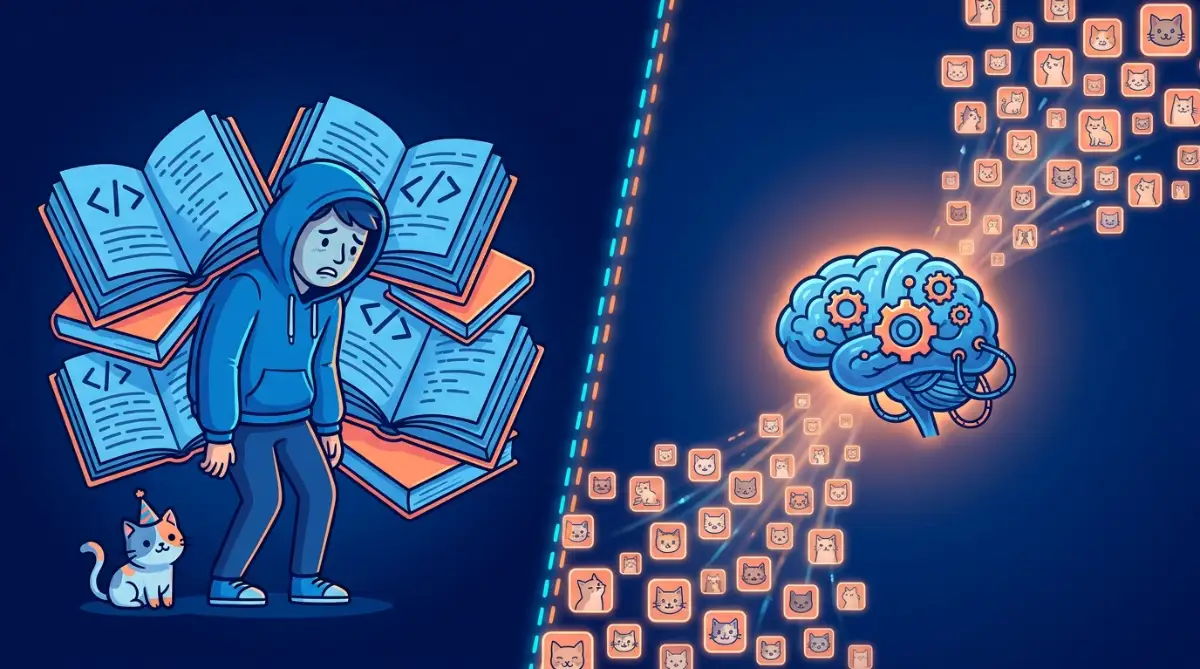
A human developer would have to write millions of individual rules just to account for every single way a cat might look in a photo.
This limitation is exactly why the tech industry hit a massive wall. Traditional coding is fantastic for strict logic, but it is completely useless for understanding messy, real-world data.
Do you want to know how the experts finally solved this impossible problem? Check out this incredible visual breakdown that completely changed my perspective on machine logic.
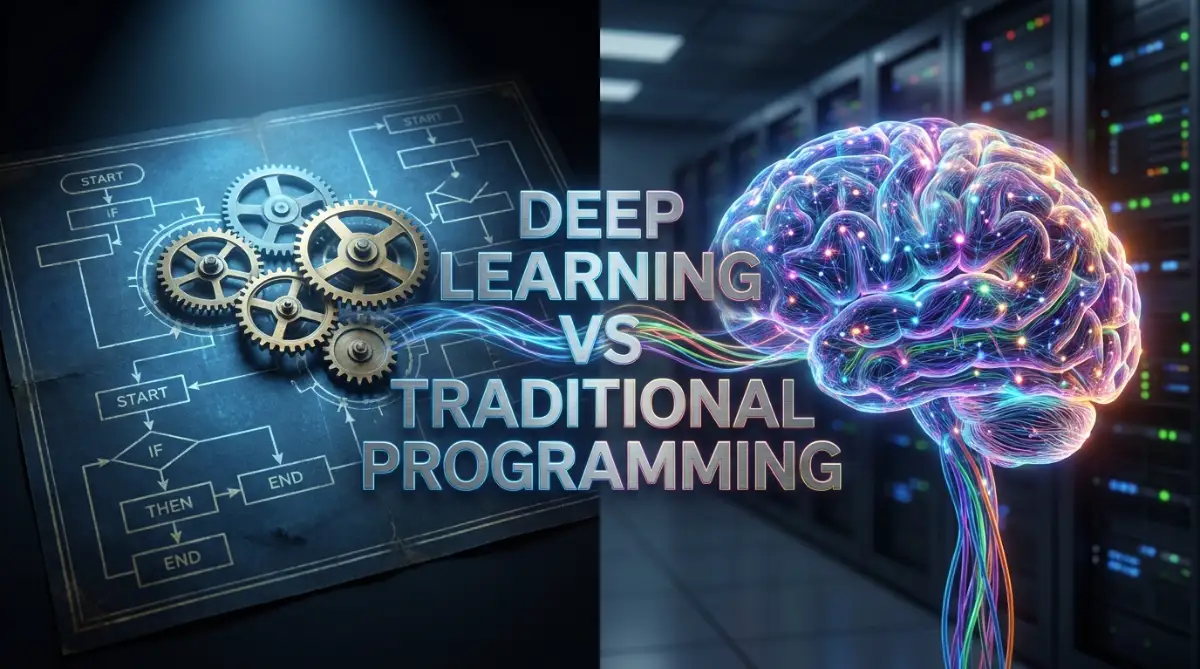
Quick Look: The Old Way vs. The Modern Way
Here is a fast breakdown of how computing has shifted over the years:
- Traditional Code: Follows strict rules. (Example: "If time is 7 AM, ring alarm.")
- Deep Learning: Learns from past habits. (Example: "User usually wakes up at 7 AM on weekdays, but sleeps in on weekends. Set alarm automatically.")
- Best Used For: Math and banking (Traditional) vs. Image and voice recognition (Deep Learning).
The Paradigm Shift: Learning by Example
This brings us to the magic of deep learning. Instead of giving the computer a rigid recipe, we completely flip the process upside down.
In this modern approach, we do not give the machine the rules. Instead, we give the machine the input data and the final answers, and we ask it to figure out the rules on its own.
Let us go back to our cat picture problem. With deep learning, nobody writes a single line of code describing pointy ears or long tails.
Instead, we gather one million photos of cats. We feed all these photos into a complex system called an artificial neural network. We tell the system, "All of these images contain cats."
Next, we feed it one million photos of dogs, cars, and trees, telling the system, "These are NOT cats."
The machine then analyzes every single pixel, pattern, and shadow in these millions of images. Slowly, through massive amounts of trial and error, it builds its own internal understanding of what a cat looks like.
It creates its own rules. It recognizes patterns that a human developer could never even begin to describe in a traditional programming language.
The Brain Connection: Artificial Neural Networks
To make this self-learning process possible, engineers looked inside the human skull for inspiration. Our brains learn through a massive web of connected neurons.
When you touch a hot stove as a child, your brain instantly fires electrical signals. You feel pain, and a connection is strengthened. Your brain learns the rule: hot stoves cause pain. Nobody had to write a manual for you to understand this.
Deep learning tries to mimic this biological process artificially. The software is structured into multiple layers of artificial neurons. These layers are stacked deep on top of each other.
The first layer might just look for simple edges or bright colors in a photo. The next layer might combine those edges to find simple shapes like circles or triangles.
By the time the data reaches the final, deepest layer, the system has combined all those tiny details into a complete understanding of the image. This multi-layered structure is exactly why we call it deep learning.
My Personal Wake-Up Call with AI Models
I used to spend hours trying to manually code simple filtering rules for my email inbox, getting frustrated when spam still slipped through. My biggest realization came when I finally let an AI-based filter handle it completely. I learned that trying to control every single variable manually is a massive waste of time when you can simply provide good examples and let the system learn the patterns for you.
Real-World Scenarios: Where the Magic Happens
Understanding the theory is great, but seeing it in action makes everything click. Let us look at a few everyday scenarios where this difference changes our lives.
Language Translation
In the past, translation software used traditional programming. Developers programmed dictionaries and strict grammar rules into the software.
The results were often terrible and highly robotic. Human language is messy. We use slang, sarcasm, and idioms that break strict grammatical rules.
Today, services like Google Translate use deep learning. They feed the system millions of books, articles, and websites that have already been translated by human professionals.
The system reads all this data and learns the natural context of words. It learns that words change meaning based on the sentence around them. This is why modern translation feels so incredibly natural and human-like.
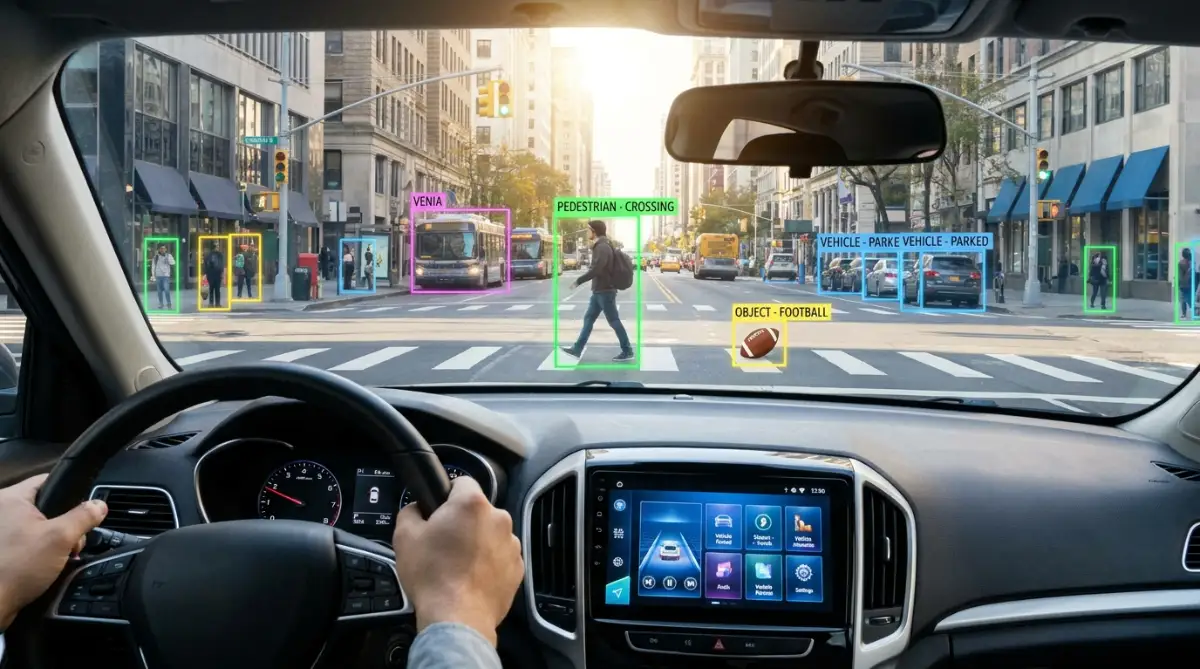
Self-Driving Cars
Can you imagine trying to write a traditional rulebook for driving a car?
"If the traffic light is red, stop. Unless a police officer is waving you forward. Or unless it is an emergency vehicle."
The real world has too many unpredictable variables for traditional if/then logic. A child chasing a ball into the street does not follow a strict mathematical formula.
Self-driving cars rely entirely on deep learning. They process massive amounts of video data from their cameras in real-time. They learn to recognize the difference between a plastic bag blowing in the wind and a heavy rock on the highway.
Myth vs Reality: Clearing the Confusion
To make sure we are fully on the same page, let us break down some common misunderstandings.
The Power of Massive Data
There is one major catch to this new way of software processing. Deep learning is incredibly hungry.
A traditional program can work perfectly fine with very little data. You just write the rules, and it runs.
Deep learning systems are entirely useless without massive, high-quality data. If you want to train a system to detect credit card fraud, you cannot just show it ten examples of fraud.
You must feed it thousands or even millions of transaction records. The system needs to see what a normal shopping day looks like for thousands of different people. Only then can it spot the tiny, hidden anomalies that indicate a stolen credit card.
This is exactly why large tech companies offer so many free services. Every time you upload a photo, send an email, or search for a video, you are providing the raw data that feeds these massive learning systems.
The Cost of Processing Power
Writing traditional code only requires a basic laptop. A simple processor can easily read human-written rules and execute them instantly.
Deep learning, on the other hand, requires massive computing power. Analyzing millions of high-resolution images to find patterns takes an incredible amount of mathematical calculation.
This requires specialized hardware, often known as Graphics Processing Units (GPUs). These highly advanced chips were originally designed to render complex video game graphics.
Engineers quickly realized that the same math used to draw millions of pixels on a screen is perfect for processing neural networks. This massive demand for computing power is what drives the current hardware industry forward.
Embracing the New Reality
We are no longer just instructing computers. We are guiding them, teaching them, and providing them with the experiences they need to grow.
You do not need to become a math genius to appreciate this shift. Just recognizing the difference between giving rules and giving examples changes how you view every piece of technology you interact with daily.
When your music app recommends the perfect song, you now know there is no tiny developer writing rules for your specific taste. It is simply a deep learning system matching your listening data against millions of other users with similar habits.
Understanding this core concept removes the fear. It takes away the mystery of modern tech and replaces it with clear, highly logical comprehension. We are shifting from an era of strict dictation to an era of data-driven discovery.
Mastering the Shift: Expert Strategies for Modern Tech
Now that we understand how machines are learning, we need to talk about how you can actually use this knowledge. You do not have to be a software engineer to benefit from this massive technological shift. The real secret is changing how you think about problem-solving in your daily life.
When you start thinking in terms of data rather than strict rules, everything changes. You begin to see opportunities for automation everywhere. Let me share some highly practical ways to adapt your mindset right now.
Think in Outcomes, Not Instructions
The biggest change you need to make is shifting your focus to the final result. In the old days of traditional programming, we obsessed over the exact steps needed to finish a task. We had to micromanage the computer constantly.
Today, you need to act more like a manager giving instructions to a highly capable assistant. You define the exact goal you want to achieve. Then, you provide the system with the right examples to help it understand what success looks like.
If you want a smart tool to sort your emails, do not try to guess every single spam keyword. Instead, spend your time carefully marking good emails and bad emails. The system will figure out the hidden patterns that you might have missed entirely.
Focus on High-Quality Information
There is an old saying in the tech world: garbage in, garbage out. This is highly relevant when dealing with deep learning systems. An intelligent model is only as smart as the information you feed it.
If you train a smart camera to recognize cars but only show it pictures of red sports cars, it will fail in the real world. It will not recognize a blue truck or a silver minivan. Your data must represent the messy, diverse reality we live in.
This is why major institutions focus heavily on data integrity before they even touch any software. For instance, researchers often rely on strict guidelines from trusted organizations like the National Institute of Standards and Technology (NIST) to ensure their information is unbiased and fair.
Combining Human Empathy with Machine Power
Machines are fantastic at finding hidden patterns in millions of rows of data. However, they completely lack human empathy, moral judgment, and common sense. They do not understand the emotional weight of a medical diagnosis or a financial rejection.
This is where your unique human skills become incredibly valuable. Your job is to take the mathematical predictions from the software and apply them with real human care. You are the bridge between cold calculations and actual people.
Interestingly, tech companies are constantly trying to bridge this emotional gap. If you are curious about this crossover, exploring how AI systems read human emotions can completely change how you view modern software design.
Protect Your Digital Environment
As our tools become smarter, they also require more access to our personal information. A learning system needs massive amounts of data to provide good recommendations. This means you have to be extremely careful about what you share.
You must protect your privacy while taking advantage of these new tools. Setting strong boundaries is just as important as knowing how the software works. For example, working safely from home with smart tools requires strictly following cybersecurity protocols for remote workers.
Always read the privacy settings on any new application you install. Ask yourself if the company is using your personal photos or messages to train their public models. Taking a few minutes to adjust your settings can save you from massive privacy headaches later.
My 3-Step Quick Privacy Check:
Before you let a new smart tool scan your files or photos, ask yourself these three things:
- Did I check the app's settings to turn off "Data Sharing for Training"?
- Does this app really need access to my camera or microphone to do its job?
- Am I logged in with a dummy email for testing, instead of my main work account?
A Real-Life Scenario: The E-commerce Upgrade
Let us look at a practical example of a small business owner upgrading their online store. Previously, they used traditional rule-based coding to show related products. The rule was simple: if a customer buys a blue shirt, show them blue pants.
This rigid logic missed massive sales opportunities. People buying blue shirts might actually prefer brown shoes, but the traditional code could never figure that out. The rules were simply too narrow.
By switching to a modern recommendation engine, the business owner let the software analyze thousands of past purchases. The system noticed that people buying blue shirts often bought a specific brand of sunglasses. The sales skyrocketed because the machine found a hidden connection no human would have programmed.
The Silent Traps That Ruin Your Tech Journey
Understanding how these systems work is incredibly empowering. However, the excitement of new technology often blinds people to some very dangerous pitfalls. I have seen smart professionals make terrible mistakes because they completely misunderstood what the software could actually do.
Let us walk through the most common traps that catch people off guard. Avoiding these specific mistakes will save you an enormous amount of time, money, and mental stress.
Blindly Trusting Machine Predictions
The most dangerous trap is assuming that a computer is always right just because it sounds confident. Deep learning models do not have a concept of truth or facts. They only calculate the probability of a specific pattern.
Sometimes, they hallucinate and make up completely fake information that looks incredibly real. If you use a smart tool to write a legal document or a medical report without checking it, you could face severe consequences. You always need a human expert to review the final output.
When you blindly trust automated tools, you open yourself up to massive risks. It is very similar to ignoring financial advice; just like the hidden costs of revolving credit lines can silently destroy your budget, hidden tech errors can completely ruin a business project.
Throwing Away Traditional Logic
Another massive mistake is thinking that traditional programming is completely useless now. This could not be further from the truth. We still need strict, unbreakable rules for the most important systems in our society.
You absolutely do not want a deep learning model guessing how much money is in your bank account based on probabilities. You want a traditional database that uses strict mathematical rules to track every single penny. Recognizing when to use strict rules and when to use flexible learning is the mark of a true professional.
Many developers waste months trying to train an intelligent model for a simple problem that could be solved with five lines of basic code. Always choose the simplest tool that gets the job done correctly.
Ignoring the Hidden Costs of Processing
People often get excited about building their own learning models without understanding the massive hardware requirements. Processing millions of data points requires huge servers and expensive graphics cards. The electricity bills alone can bankrupt a small startup.
If you are not careful, cloud computing platforms will charge you thousands of dollars for running an inefficient model. You must plan your budget extremely carefully before starting any heavy data processing project.
Financial planning in technology is non-negotiable. Just as you need specific strategies when adding a teen driver to your insurance policy to avoid going broke, you must monitor your cloud computing costs daily.
The Expert Insight: Embracing the Grey Area
I used to get incredibly frustrated when an intelligent program gave me a slightly different answer every time I asked the same question. My breakthrough happened when I realized these systems are not calculators; they are creative problem solvers. I stopped expecting perfect mathematical consistency and started treating the software like a brainstorming partner, which completely removed my daily tech stress.
Overcomplicating Your Learning Path
Many beginners make the mistake of thinking they need to learn advanced calculus to understand modern software. They buy massive textbooks and sign up for incredibly expensive university courses. This usually leads to severe burnout within the first month.
You do not need to understand the complex math to use the tools effectively. You just need to understand the core concepts and how to apply them. Start playing with free, user-friendly tools online before diving into heavy academic theory.
Learning new skills should never put you in massive debt. Focus on accessible resources so you never have to worry about needing a guide to student loan forgiveness later in life.
Treating Technology as a Magic Wand
It is incredibly common for business leaders to buy a shiny new intelligent software package and expect their profits to double overnight. They think the software will magically fix their broken company culture or their poor customer service.
Technology is merely an amplifier of what already exists. If your core business processes are terrible, adding advanced software will just make those terrible processes run faster. You must fix the underlying human problems before you apply machine solutions.
For deep insights on how to ethically and practically implement these tools in a corporate environment, reading resources from the Harvard Business Review can provide excellent strategic guidance.
Your Personal Blueprint for the Future
We have covered a massive amount of ground today, moving from the strict rules of traditional coding to the flexible patterns of modern learning. You now hold a very clear advantage over people who are still confused by the tech jargon. You understand that this is simply a shift from writing instructions to providing good examples.
This knowledge is your shield against the fear of missing out. You do not have to feel overwhelmed when you read tech news anymore. You can look past the complicated buzzwords and see the simple logic hiding underneath.
Building Your Action Plan
Your very next step should be highly practical and completely stress-free. Start paying close attention to the apps you use every single day. Try to guess which ones are using strict traditional rules and which ones are using pattern recognition.
When your GPS reroutes you around a traffic jam, think about the millions of data points it is processing in real-time. When you use a simple calculator app, appreciate the flawless, strict logic of traditional coding. This simple mental exercise will train your brain to spot the differences instantly.
Protecting your digital assets and understanding the tools you use is essential for peace of mind. It is exactly like having proper uninsured motorist coverage; you might not need it every day, but understanding how it works saves you when things get complicated.
The Value of Continuous Curiosity
The technology industry will keep evolving at a rapid pace. New methods will emerge, and old methods will be updated. The only way to stay relevant is to maintain a sense of playful curiosity.
Do not be afraid to break things in a safe environment. Sign up for free trials of new software platforms. Play around with data sets and see what happens when you change the inputs.
If you want to read high-level research without getting bogged down in jargon, trusted scientific journals like Nature often publish excellent summaries of where machine intelligence is heading next.
Staying Grounded in a Digital Era
Remember that the ultimate goal of all this software is to make human life better. We did not invent complex algorithms just to show off our mathematical skills. We built these tools to solve real human problems, cure diseases, and eliminate boring tasks.
Do not let the machine completely take over your decision-making process. Use it to gather information and spot trends, but always rely on your human intuition for the final call. The most successful professionals are the ones who combine artificial speed with human wisdom.
I truly believe that once you strip away the intimidating vocabulary, anyone can master these concepts and take control of their digital life. My personal hope is that you close this page today feeling confident, inspired, and completely ready to use these amazing tools to build something incredible for yourself.
Common Questions About Machine Logic and Coding
Do I need to learn advanced math to use modern software tools?
Absolutely not. Unless you are trying to build a brand new algorithm from completely scratch, you do not need advanced math. Most people use highly accessible platforms that handle all the complex calculations automatically behind the scenes.
Will traditional coding jobs completely disappear soon?
No, traditional programming is definitely here to stay for a very long time. We will always need strict, precise coding for things like banking systems, database management, and building the core architecture of operating systems.
Can I run a deep learning system on my home computer?
You can run very small, simple models on a standard home computer for learning purposes. However, training large, professional-grade systems requires massive servers and specialized graphics cards that most people rent through cloud providers.
How long does it take to understand the basics of machine learning?
If you focus purely on the core concepts rather than the complex coding, you can grasp the basics in just a few weeks. The key is to avoid heavy textbooks and instead focus on visual examples and hands-on experiments.
Why does the software sometimes give me completely wrong answers?
These systems do not actually understand the real world; they only understand statistical probabilities based on their training data. If they encounter a situation they have never seen before, they will simply guess, which often leads to highly confident but entirely incorrect answers.
Disclaimer: The information provided in this article is for educational and informational purposes only and does not constitute professional tech, financial, or career advice. Software platforms and technology standards change rapidly; always conduct your own research or consult with a certified tech professional before making significant investments in software or hardware.