The Silent Takeover: How I Lost My Mind to Convenience
Last Tuesday, my internet dropped for exactly three hours, and I completely froze. I could not cook my dinner, find my way to a friend's house, or even remember my own sister's phone number. Staring at a dead Wi-Fi router made me realize something terrifying: my brain is not really mine anymore.
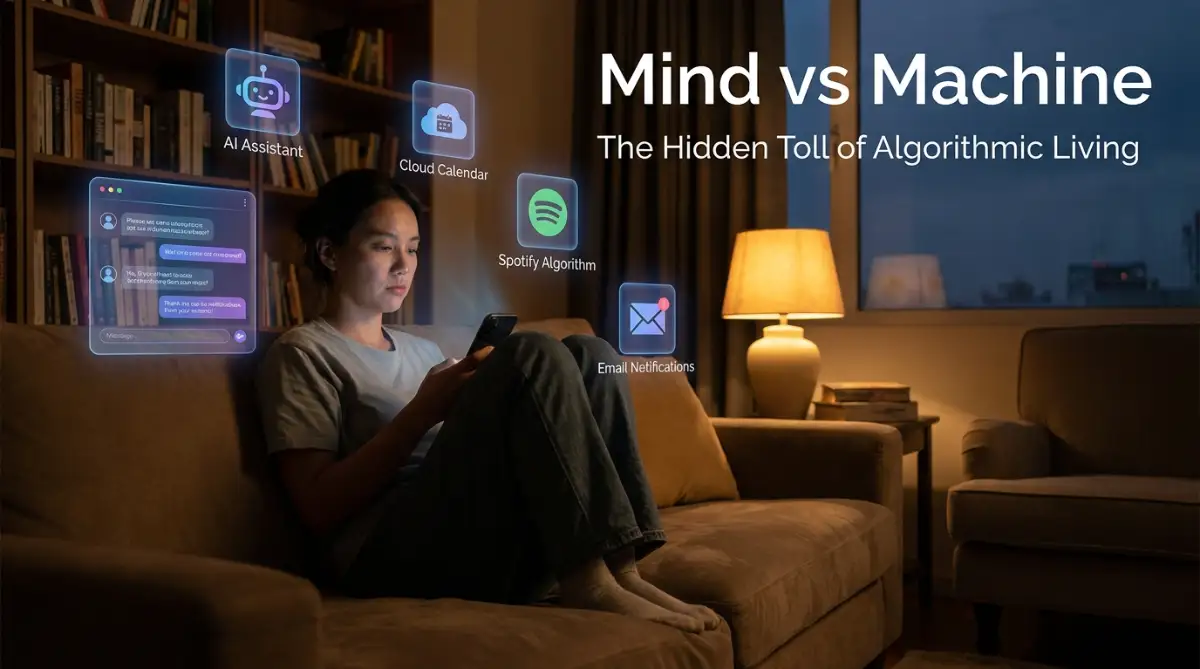
This is not just a personal struggle anymore. Millions of ordinary people are waking up to this exact same mental fog every single morning. We have invited these helpful algorithms into our bedrooms, kitchens, and pockets. They tell us when to wake up, what music matches our mood, and exactly which route to drive to work.

At first, this level of convenience feels like absolute magic. You never have to think hard, you never get lost, and you always get exactly what you want. But beneath this comfortable surface, our mental health is silently paying a massive price.
When you stop making small decisions, your brain simply stops practicing how to choose. We are experiencing extreme decision fatigue, not because we have too many choices, but because we are terrified of making the wrong one without our digital helpers. Average people are feeling massive spikes in daily anxiety whenever their internet connection drops.
Quick Takeaways: Reclaiming Your Mind
- Stop the Auto-Pilot: Wait exactly 10 minutes before asking a screen for simple answers or facts.
- Embrace the Unknown: Take a different route home today without looking at a digital map.
- Keep it Analog: Designate specific rooms (like your bedroom) as strictly tech-free zones.
- Build Mental Muscle: Force yourself to memorize one small detail or phone number every single day.
Escaping the Algorithmic Bubble: A Guide to Getting Your Brain Back
The Illusion of Free Will in a Computed World
We like to think we are in total control of our daily choices. You sit down after a long day, open a streaming app, and pick a movie. You feel completely independent in that moment.
But the reality is far more complicated than that simple click. The algorithm has already studied your past behavior, your mood patterns, and your micro-habits. It presents you with five highly specific options, secretly guiding your hand toward the one it wants you to pick.
You did not really choose that movie; the math simply predicted your exact reaction. This constant, invisible hand holding creates a dangerous psychological bubble around us. We are slowly losing our ability to discover things naturally by accident.
When was the last time you stumbled upon a great restaurant just by walking around? We now refuse to enter any building unless a digital map gives it a solid 4.5-star rating. We trust the machine's opinion much more than our own human intuition.
Quick Self-Test: Are You Machine-Dependent?
Ask yourself these three rapid-fire questions right now:
- Can you name the phone numbers of your 3 closest friends from memory?
- Did you actually pick your last favorite song, or did an app autoplay it?
- Have you walked into a random café recently without checking its star rating online first?
- If you answered "No" to most of these, an invisible code is likely driving your daily choices.
This extreme dependence kills our natural curiosity and makes our world incredibly small. We stop taking risks, and our brains stop getting the healthy stimulation that comes from unexpected surprises.
Myth vs Reality: What We Get Wrong About Smart Assistants
People often misunderstand what these helpful machines are actually doing to our daily routines. Let us clear up some of the biggest misunderstandings right now.
Myth: Virtual assistants save us so much time that we can finally relax and enjoy life.
Reality: We fill every single second of that "saved time" with more digital consumption. Instead of relaxing, we just scroll deeper into social media feeds driven by even more algorithms.
Myth: Using GPS apps every day makes us better drivers because we avoid traffic jams.
Reality: Our spatial awareness is dropping dramatically. Many people can no longer mentally map their own cities without looking at a glowing blue line on a screen.
Myth: Personalized music playlists help us discover new art we truly love.
Reality: They keep us trapped in an echo chamber of the exact same sounds. Our taste never naturally evolves because the machine is too scared to challenge our ears.
Rewiring Your Brain for Independent Thinking
To fix this growing problem, we have to start treating our brains like a physical muscle. When you stop lifting weights, your muscles shrink and become weak.
The exact same thing happens to your memory and problem-solving skills when an algorithm does all the heavy lifting. You must actively introduce small amounts of healthy friction back into your life. Friction makes you pause, think, and engage with the real world around you.
Start by reclaiming your simple, daily decisions from the machines. Do not ask your speaker for the weather forecast every single morning. Simply open your front door, step outside, and feel the air for yourself.
These tiny moments of independence send powerful signals to your brain. They tell your nervous system that you are still capable, aware, and in charge of your own environment.
Here is a highly effective resource on understanding how our brains react to this digital dependency.
The Concept of Digital Amnesia
Psychologists have started studying a deeply worrying trend known as digital amnesia. Because our phones remember every birthday, phone number, and meeting, our brains simply delete that information.
We subconsciously believe there is absolutely no reason to store facts in our heads anymore. But memory is deeply connected to our personal identity and emotional intelligence. When you lose the ability to remember small details about the people you love, your relationships slowly become shallow.
I remember a terrifying moment last month when my phone battery died completely while I was downtown. I realized I could not remember my own sister's phone number to call for a ride. I had to walk into a coffee shop and just sit there in a panic, feeling entirely helpless because my external digital brain was turned off. That was the exact wake-up call I needed to start memorizing important things again.
You can fight this amnesia by memorizing just one small thing every single day. Start with the phone numbers of your three closest family members. It sounds basic, but the act of forcing your brain to recall numbers builds stronger neural pathways.
Algorithmic Living vs Intentional Living
To truly understand how this shifts our mindset, we need to look at the differences between living automatically and living with purpose.
Practical Steps to Break the Invisible Chains
Breaking free from this intense psychological grip does not mean you have to throw your smartphone in the garbage. Technology is incredibly useful when you treat it like a tool instead of a trusted friend.
The goal is to rebuild your mental boundaries so the machine works for you, not the other way around. Let us explore some powerful ways to reclaim your human independence today.
1. Implement the "Wait 10 Minutes" Rule
Whenever you feel the sudden urge to ask a digital assistant for information, just stop. Force yourself to wait exactly ten minutes before using the device.
During this short window, try to figure out the answer using your own brain power. If you are trying to remember the name of an actor in a movie, let your mind search for the memory naturally. This small delay acts as a fantastic workout for your memory recall abilities. You will be completely shocked at how often your brain remembers the answer at minute number eight.
2. Embrace Getting Slightly Lost
We have developed a deep, unnatural fear of taking the wrong turn. GPS algorithms have convinced us that getting lost is a terrible disaster that must be avoided at all costs.
But wandering around is exactly how humans have discovered amazing things for thousands of years. Once a week, try driving or walking home using a completely new route without opening a map app.

Pay close attention to the trees, the strange buildings, and the shape of the roads. If you take a wrong turn, do not panic; just use your logic to course-correct.
3. Stop Outsourcing Your Written Voice
One of the most dangerous trends right now is using smart algorithms to write our personal emails and text messages. Predictive text and AI writing tools want to make our communication perfectly efficient.
But human communication is not supposed to be perfectly efficient. It is supposed to be messy, emotional, and uniquely yours. When you let an algorithm write your messages, you slowly lose your personal tone of voice. People stop connecting with you because your words sound like they came from a polite robot. Turn off the auto-reply suggestions and start typing your own messy, authentic thoughts again.
4. The Analog Weekend Experiment
Give your mind a massive reset by dedicating one day a week to purely analog activities. This means reading physical paper books instead of digital screens.
It means listening to an entire vinyl record or a CD from start to finish, without letting an algorithm skip the slow songs. When you consume physical media, you engage your senses of touch and smell. This multi-sensory experience deeply grounds your mind in reality and completely destroys digital anxiety. Your brain desperately needs this heavy, physical connection to the real world to stay healthy.
5. Challenge Your Algorithmic Echo Chamber
Algorithms are designed to keep you happy by only showing you things you already agree with. Over time, this makes our minds incredibly rigid and highly intolerant of different opinions.
You must actively trick the system to keep your perspective broad and healthy. Start searching for topics, music genres, and hobbies that you normally completely ignore. Watch a documentary about a subject you know absolutely nothing about. Force the algorithm to present you with strange, unfamiliar information so your brain has to work hard to process it.
By taking these small, deliberate actions, you slowly push the machines back into their proper place. You stop being a predictable data point and become a messy, beautiful, independent human being again. The psychological relief you will feel when you finally make your own unfiltered choices is completely life-changing.
Advanced Strategies for Mastering Your Mind Against the Machine
Taking back your independence from smart devices requires more than just unplugging a single speaker. You need a deeply intentional approach to rewrite your daily habits and protect your mental space. Let us explore some powerful, expert-level strategies that will keep your mind sharp for the long haul.
We often think that willpower alone is enough to beat algorithmic addiction. But your brain is fighting against billions of dollars of research designed to keep you hooked. You need systems, not just motivation. Think of this process as building a completely new mental framework.
You can actually manage your personal habits much like successful companies manage massive projects. By adopting strategies similar to agile methodologies for startup growth, you can test small behavioral changes in your daily life, adapt quickly, and find exactly what works for your unique situation. Small, consistent tweaks always beat massive, sudden changes.
Create Strict Tech-Free Zones in Your Home
Your physical environment heavily dictates your mental habits. If you have a smart assistant sitting on your kitchen counter, your brain will naturally want to use it. You must create physical boundaries to give your mind a break.
Start by completely banning all algorithmic devices from your bedroom. This is your ultimate sanctuary for rest and human connection. When you remove the temptation to ask a robot to set your morning alarm, you force yourself to use a traditional clock. This tiny shift immediately reduces your morning anxiety and stops the cycle of immediate digital consumption the second you open your eyes.
According to researchers analyzing the psychological effects of sleep environments, keeping digital distractions out of your resting space significantly lowers nighttime stress hormones. When your brain knows the machine is not listening, your nervous system finally relaxes.
The 7-Day Tech-Free Bedroom Reset
Let us ditch the theory and get practical. Here is exactly what happens when you kick smart devices out of your sleeping space:
- Days 1-2: You feel phantom vibrations and keep checking your nightstand for a phone that isn't there.
- Days 3-4: You actually start looking at the ceiling, letting your thoughts naturally wander before falling asleep.
- Days 5-7: You wake up feeling significantly less rushed because a bright screen isn't the very first thing your eyes see.
Practice Cognitive Resistance Training
We go to the gym to lift heavy weights so our physical bodies stay strong. You must apply this exact same concept to your memory and problem-solving skills. I call this "Cognitive Resistance Training."
Instead of taking the path of least resistance every single time, intentionally make some tasks harder. Do mental math at the grocery store instead of pulling out your phone calculator. Try to recall the names of actors in a movie without looking them up online.
These tiny moments of healthy frustration are actually your brain building new neural pathways. We should absolutely celebrate AI when it is solving massive global problems, like transforming healthcare diagnostics. However, we simply do not need heavy machine learning to tell us how to boil an egg or what the weather looks like outside our own window.
Gamify Your Digital Independence
Human beings naturally love playing games and winning challenges. You can use this psychological trick against the algorithms. Turn your journey toward digital independence into a fun, personal game.
Challenge yourself to navigate to a new restaurant using only a printed map or written directions. Give yourself a point for every entire day you go without asking a virtual assistant a single question. Treat your personal identity like a valuable asset. Just as you might focus on building a strong personal brand by staying authentic and true to your voice, you must protect your authentic thoughts from being shaped entirely by predictive text.
When you gamify the process, it stops feeling like a painful restriction. It suddenly becomes an exciting adventure to see how capable you still are. You will find immense joy in realizing your human intuition is often much faster and more creative than a machine's suggested response.
Embrace the Concept of "Algorithmic Fasting"
You have probably heard of nutritional fasting for physical health. Algorithmic fasting works exactly the same way for your mental clarity. You simply choose specific windows of time where you consume zero personalized digital content.
During this fasting window, you do not check recommended feeds, you do not listen to auto-generated playlists, and you do not ask smart speakers for help. You only consume media you intentionally searched for by name. Studies found in the National Library of Medicine regarding digital detoxing show that even short periods away from algorithmic feeds can significantly restore your baseline dopamine levels.
Your brain will crave the easy dopamine hits at first. But after a few days of consistent fasting windows, the mental fog begins to lift. You will suddenly find yourself having original thoughts that were not perfectly planted there by a targeted advertisement.

The Dangerous Traps of Detoxing (What to Avoid)
When people finally realize the heavy mental toll of living on autopilot, they often panic. They try to fix everything in a single weekend, which almost always leads to disaster. Understanding the hidden traps of this journey is just as important as knowing the right steps to take.
Changing your deep psychological habits requires immense patience and self-compassion. If you rush the process, you will likely rebound and become even more dependent on your devices than before. Let us break down the most severe mistakes people make when trying to reclaim their minds.
The "Cold Turkey" Illusion
The single biggest mistake people make is trying to disconnect from everything all at once. They unplug all their smart speakers, delete every app, and try to live like it is a century ago. This extreme approach deeply shocks your nervous system.
Your brain has grown accustomed to relying on these digital crutches. When you remove them all overnight, you will experience intense spikes of anxiety and severe decision paralysis. It is very similar to ignoring your financial reality; much like the complex traps of understanding debt consolidation, trying to quickly hide the problem without a proper long-term strategy usually makes your situation much worse.
Instead of going cold turkey, you must slowly phase out the algorithms. Turn off the smart speaker in the living room first, but keep the navigation app in your car for another week. Slow, deliberate progress is the only way to make the changes stick permanently.
Replacing One Screen for Another
Many individuals successfully stop talking to their virtual assistants, only to replace that habit with an even worse one. They stop asking for news updates out loud, but start doom-scrolling on their phones for two hours every morning.
Your brain simply trades one form of digital dependence for another. You have not actually solved the core issue of outsourcing your attention. You must actively replace digital habits with physical, analog activities to truly heal your mind.
If you turn off your personalized music algorithm, do not just turn on a random digital radio station. Put on a physical vinyl record, play a musical instrument, or simply sit outside and listen to the birds. You must fill the empty space with genuine, physical reality.
Ignoring the Social Friction
We live in a deeply connected society, and your personal digital habits directly affect the people around you. When you suddenly decide to stop using shared calendar algorithms or smart home features, your family might get extremely frustrated.
You cannot simply force your new lifestyle onto your partner or your children without a conversation. Ignoring this social reality leads to heavy arguments and unnecessary stress at home. Clear communication is your best tool here.
Explain exactly why you are making these changes and how it is helping your mental health. In professional environments, managing these changes requires structure. You can look at software project management frameworks as a great example of how teams handle transitions smoothly by setting clear expectations and rules. Treat your family like a team, and find compromises that respect everyone's comfort levels.
Fearing Boredom and Silence
Algorithms are incredibly good at completely destroying boredom. The second you feel slightly under-stimulated, a device chimes with a perfectly timed notification or a funny video suggestion. We have forgotten how to just sit quietly with our own thoughts.
When you start pulling away from this technology, you will inevitably feel bored. Many people view this boredom as a massive failure and immediately rush back to their screens. According to behavioral science reports from Harvard University regarding digital wellness, allowing yourself to feel bored is actually the exact trigger your brain needs to spark deep creativity.
You must embrace the quiet moments. Let your mind wander aimlessly. Do not immediately reach for a podcast when you are doing the dishes or folding laundry. That empty, silent space is exactly where your best human ideas are quietly waiting to be discovered.
Your Roadmap to Authentic, Unfiltered Living
Reclaiming your mind from the invisible grip of algorithms is one of the most rewarding journeys you will ever take. It is not about completely rejecting the modern world or hating technology. It is about remembering that you are the master of your own life, and these devices are simply your quiet servants.
When you stop letting machines make your micro-decisions, the world suddenly feels much bigger. You start trusting your own memory again, and you begin to notice the beautiful, messy details of reality. Your relationships become deeper because you are fully present, not constantly waiting for a digital prompt to tell you what to do next.
Every time you choose to navigate a new street using your own eyes, you are fighting back against digital amnesia. Every time you cook a meal without asking a screen for step-by-step instructions, you are proving your own competence. These tiny, daily acts of rebellion build a massive wall of mental strength.
Human error is not something we should try to eliminate with perfect algorithms. Taking a wrong turn, picking a movie you end up hating, or burning a batch of cookies—these are the experiences that make life interesting. Perfection is incredibly boring, and a life completely smoothed out by artificial intelligence lacks genuine character.
A Personal Note to You:
I know exactly how overwhelming it feels to realize your daily habits are mostly controlled by glowing screens and hidden codes. But my own life completely transformed the day I decided to trust my human instincts again over a machine's perfect advice. Start incredibly small today—leave your phone in another room for just one hour—and I promise you will immediately feel a beautiful sense of freedom rushing back into your mind.
Common Questions About Breaking Digital Dependence
How long does it take to fix digital amnesia?
Your brain is incredibly adaptable, and you can see improvements very quickly. Most people report a significant return of their natural memory recall within just two to three weeks of reducing their reliance on digital assistants. The key is consistent, daily practice of trying to remember small details before looking them up.
Will turning off personalized algorithms ruin my entertainment?
Not at all; it will actually deeply enrich it over time. While the first few days might feel slightly frustrating, you will soon start discovering books, movies, and music completely outside your normal bubble. This active discovery process brings back the genuine excitement of finding something unique on your own.
Is it safe to stop using GPS for daily driving?
Yes, it is perfectly safe to navigate familiar routes without digital assistance. Start by turning off the map app for your basic commute to work or the grocery store, and slowly expand your comfort zone. Always keep the app available for real emergencies, but rely on your own spatial awareness for everyday local travel.
How do I talk to my family about using smart speakers less?
Approach the conversation by focusing entirely on your own mental health rather than criticizing their habits. Explain that you are feeling overwhelmed by the constant digital noise and kindly ask if certain rooms can become tech-free zones. Finding a middle ground, like keeping the speaker in the kitchen but removing it from the dining room, usually works perfectly.
Can I still be productive without virtual assistants?
Absolutely. In fact, your deep focus and genuine productivity will likely skyrocket. While virtual assistants are great for setting quick timers, they constantly interrupt your deep thinking with notifications and suggestions. True productivity comes from uninterrupted human focus, not from a machine trying to manage every second of your day.
Disclaimer: The information provided in this blog post is for educational and informational purposes only and does not constitute professional psychological or medical advice. The strategies discussed are based on personal experience and general behavioral research. If you are experiencing severe anxiety, digital addiction, or heavy mental health struggles, please consult with a licensed therapist or certified medical professional for personalized care. External links to third-party resources are provided for convenience and do not imply a complete endorsement of their entire content.