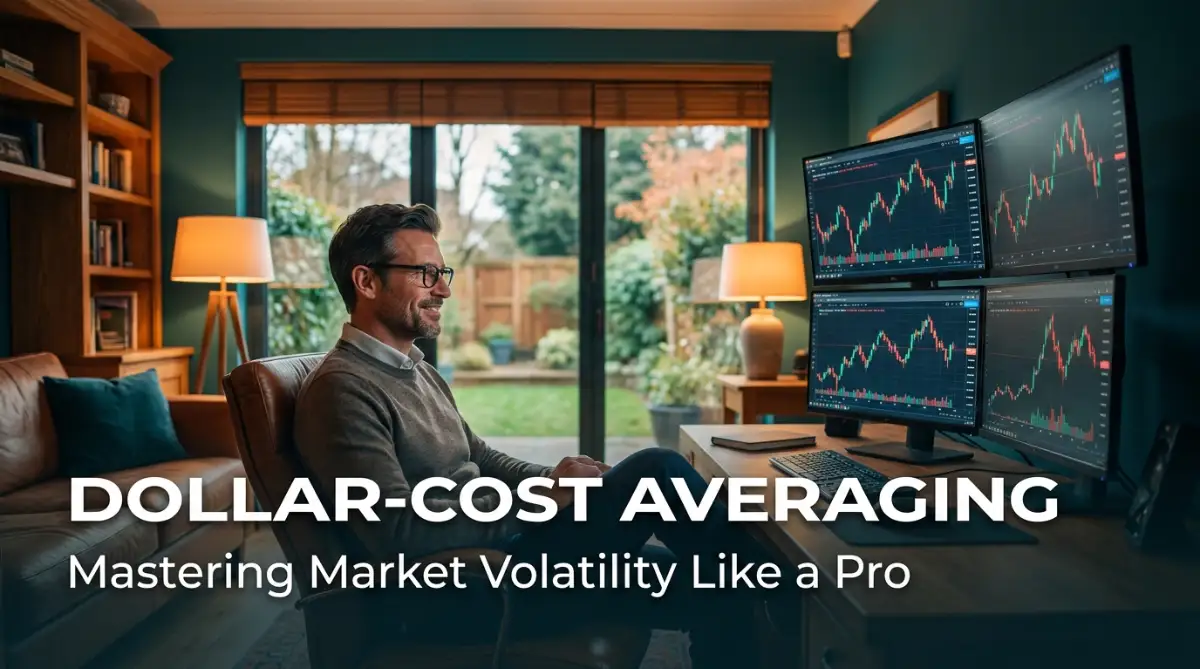
Surviving the Chaos: My Wake-Up Call in a Crashing Market
Have you ever lost sleep over a shrinking bank account? Trust me, I know the feeling. Not too long ago, I watched my investments tank in a single afternoon and quickly realized my guessing game was not working at all. That is exactly when I found a stress-free way to invest your money—one that actually lets you sleep soundly at night.
Instead, the market decided to punish my impatience and greed. I felt completely trapped, sick to my stomach, and angry at myself for making such a rookie mistake. That night, I promised myself I would find a safer way to grow my money without losing my sanity.
Ordinary people face this exact nightmare every single day in the financial world. You work incredibly hard for your money, only to watch it vanish because of unpredictable market swings. The stress of constantly checking price charts ruins your focus at work and destroys your peace at home.
You start questioning your intelligence and your ability to provide for your future. The fear of losing everything keeps you up at night, creating a cycle of endless worry. But the truth is, the problem is not the market itself. The real problem is how we choose to approach it.

💡 Quick Takeaways for Your Wallet
- Stop guessing: Trying to time the market perfectly is a guaranteed way to lose your money and your peace of mind.
- Automate your buys: Set up a system to buy a fixed dollar amount every week or month, totally ignoring the current price.
- Embrace the drops: Market crashes are secretly your best friend because they give you a massive discount on good assets.
- Keep cash ready: Always build an emergency fund first so you never have to sell your investments in a blind panic just to pay rent.
Escaping the Trap of Timing the Market
Most beginners think they can easily outsmart the global financial system. They watch a few videos, look at some colorful charts, and believe they can buy at the exact bottom. Then, they expect to sell at the absolute top.
This is a massive illusion that costs ordinary investors billions of dollars. Professional traders with huge teams and advanced computers struggle to predict market movements accurately. So, thinking you can do it consistently from your living room is a very dangerous game.
When you try to guess the perfect time to buy, you let your emotions drive the car. If prices are soaring, your brain screams at you to buy before you miss out. If prices are crashing, your brain screams at you to sell everything before it goes to zero.
This emotional tug-of-war is exhausting and highly unprofitable. You need a mechanical system that completely removes human emotion from the equation. You need a strategy that works quietly in the background, whether the market is up, down, or sideways.

What Exactly is Dollar-Cost Averaging?
Let me explain this concept in the simplest way possible. Imagine you want to buy your favorite coffee beans, but the price changes every single week. Sometimes it is very expensive, and sometimes it is incredibly cheap.
Instead of trying to guess when the coffee beans will be cheapest, you decide to spend exactly $20 on coffee beans every Friday. When the price is high, your $20 buys fewer beans. When the price is low, your $20 buys a lot more beans.
Over time, the average price you paid per bag of coffee will actually be lower than if you tried to guess the perfect time to buy. This is the exact math behind Dollar-Cost Averaging (DCA).
You simply take a fixed amount of money and invest it at regular intervals. It does not matter if you are buying stocks, index funds, or digital assets. The rule remains exactly the same. You buy every day, every week, or every month without looking at the price.
Here is a quick breakdown of how this math actually works if you commit to spending $50 every month:
Real Talk: You spent $150 total and walked away with 20 shares. Your average cost dropped to just $7.50 per share, which is way cheaper than the normal $10 price tag!
Why This Simple Math Works Wonders
By investing a fixed dollar amount, you automatically buy more shares when prices are cheap. You naturally buy fewer shares when prices are highly expensive.
This completely smooths out your purchase price over the long run. If the market takes a sudden dive, you don't panic. In fact, your automated system just bought assets at a heavy discount for you.
You stop caring about daily news updates and social media hype. You stop waking up in the middle of the night to check your portfolio balance. You just let the math do the heavy lifting while you enjoy your daily life.
I used to think I was a trading genius when I got lucky on a random coin once. But then I lost almost everything trying to replicate that luck by dropping a massive lump sum at the very peak. I quickly realized that slow, boring, and highly consistent investing is the real secret to keeping your money safe and watching it grow.
If you want to see exactly how a small weekly investment can turn into a massive portfolio over time, this quick breakdown will blow your mind.
[Insert YouTube Video Link Here]
The Psychology of a Calm Investor
The biggest advantage of this method is not just the financial return. The greatest benefit is the absolute peace of mind it gives you. Money is highly emotional, and watching your net worth drop by thirty percent in a week hurts deeply.
When you use the DCA method, a market crash actually becomes a positive event. Your brain learns to see falling prices as a clearance sale rather than a terrifying disaster.
You know that your next automated purchase will scoop up those cheap assets. This simple shift in mindset completely changes how you experience the financial world. You become a steady collector of assets instead of a frantic gambler.
Breaking Down the Lump Sum vs DCA Debate
Many people wonder if they should just invest all their cash at once. Let's look at a simple comparison to see how they stack up against each other.
If you invest everything on a Tuesday, and the market crashes on Wednesday, you will feel sick. You will have zero cash left to take advantage of the newly dropped prices.
With a staggered approach, you always have a little cash flowing in to catch the dips. It acts as a natural shock absorber for your financial journey.
Myth vs Reality in Everyday Investing
There are so many false stories floating around about how to get rich in the markets. Let's clear up some of the biggest misunderstandings right now.
Myth: You need thousands of dollars to start investing properly.
Reality: You can easily start this automated strategy with just ten or twenty dollars a week. Consistency matters way more than your starting amount.
Myth: You have to read charts and watch financial news all day.
Reality: The best investors are usually the ones who look at their accounts the least. Automation does the job much better than human intervention.
Myth: This strategy only works for the stock market.
Reality: It works exceptionally well for highly volatile assets like digital currencies. In fact, higher volatility makes the averaging effect even more powerful.
Setting Up Your Automated Wealth Engine
To make this work, you must remove yourself from the process. If you have to manually log in and hit the "buy" button every Friday, you will eventually fail.
You will look at a red chart and think, "Maybe I should wait until it drops lower." Or you will look at a green chart and think, "It is too expensive today."
You have to set up an automatic recurring buy on your preferred exchange or brokerage app. Almost every major platform offers this feature today.
You simply link your bank account, choose the asset, select the dollar amount, and pick the frequency. Once you hit confirm, you close the app and go live your life.
Choosing the Right Frequency
Should you buy daily, weekly, or monthly? Honestly, the mathematical difference over a ten-year period is very small.
The best frequency is the one that naturally aligns with your income. If you get paid every two weeks, set your automatic purchases for every two weeks.
If you run a business with daily cash flow, maybe a small daily purchase makes sense. The goal is to make the investment feel like a normal, invisible utility bill. You pay it automatically without giving it a second thought.
Why Market Volatility is Actually Your Best Friend
Most people view wild price swings as a terrible thing. They want their investments to go up in a perfectly straight, smooth line.
But if prices never dropped, you would never get a chance to buy things on sale. Volatility is simply the heartbeat of the market. It moves up and down constantly, shaking out the nervous hands.
When you use the averaging method, you actually need the price to drop sometimes. Those drops are what lower your overall average cost per share.
If you are buying a solid, fundamentally strong asset, a fifty percent price drop is a gift. Your automatic system will quietly collect double the amount of shares that week. When the market eventually recovers, your profits will multiply much faster.
Managing Risk Like a True Professional
Even with a safe strategy, you still need to protect yourself from bad assets. Dollar-Cost Averaging will not save you if you are buying garbage.
If a company is going bankrupt, averaging your cost down to zero still leaves you with zero. You must apply this strategy only to high-quality assets that you believe will survive for decades.
Broad market index funds are usually the safest bet for ordinary people. If you are venturing into digital assets, sticking to the top two or three most established networks is the smartest move.
Never try to average down on random, unnamed internet coins hoping for a miracle. Protect your hard-earned money by investing in things that have real-world value and a strong track record.
Think about it this way: Warren Buffett didn't build his massive fortune by jumping into random internet trends. He bought solid businesses and just waited patiently. I use a very simple rule for my own hard-earned cash—if I cannot easily explain how an asset actually makes money to a 10-year-old, I completely avoid buying it.
By following these simple rules, you take back control of your financial destiny. You stop letting the news dictate your mood and your wallet. You slowly, quietly, and firmly build a wall of financial security around yourself and your family.
Taking Your Automated Investments to the Next Level
Once you understand the basic math behind consistent investing, you might want to explore some advanced strategies. Ordinary people often stop at the basic level, but a few small tweaks can massively improve your results.
The goal here is not to complicate your life with messy charts. Instead, we want to optimize your automated system so it works even harder while you sleep. By making a few smart adjustments, you can safely maximize your returns without adding extra stress.
Let me introduce you to a concept called dynamic purchasing. Regular averaging means you buy the exact same dollar amount every single week. Dynamic purchasing means you slightly adjust that amount based on how the market is performing.
For example, let us say your normal automatic purchase is fifty dollars every Friday. If the market suddenly drops by twenty percent, you might manually bump that week's purchase up to seventy-five dollars. You are basically buying extra items when they go on a massive clearance sale.
When the market shoots up and becomes incredibly expensive, you drop your purchase down to twenty-five dollars. This keeps you actively buying, but it protects your cash when prices are dangerously high. It is a very simple way to use human behavioral economics to your advantage.
Building a Safe Cash Buffer
Before you even think about putting money into volatile assets, you must have cash sitting on the sidelines. I cannot stress this enough. If you are investing money that you need for next month's rent, you are playing a losing game.
When you invest money you actually need for survival, you panic the moment prices drop. You are forced to sell your assets at a heavy loss just to pay your bills. This entirely defeats the purpose of building long-term wealth.
You need to establish proper emergency cash reserves in a boring, traditional savings account. This cash buffer gives you massive psychological comfort when the digital asset market crashes. You can sleep peacefully knowing your daily life is completely unaffected by falling red candles.
Staring at plunging charts without a safety net can actually ruin your mental health. In fact, financial stress is a leading reason why you feel mentally drained all the time, making it impossible to focus on your day job. Protect your mind by keeping a solid cash barrier between your investments and your living expenses.
The Power of Routine Portfolio Maintenance
Even with an automated buying strategy, you cannot just ignore your portfolio forever. Over a long period, some of your assets will grow much faster than others. This can accidentally throw your entire financial plan out of balance.
Imagine you started by putting half your money into digital currencies and half into traditional index funds. If the digital market goes on a massive run, it might suddenly make up ninety percent of your total wealth. That means you are now taking on way too much risk without even realizing it.
Every few months, you should log in and do a simple rebalancing act. You sell a small portion of the winner and use that cash to buy more of the underperforming asset. This forces you to legally take profits while strictly managing risk during market turbulence.
Just like mastering difficult mental concepts requires regular review and practice, managing wealth requires occasional check-ins. You do not need to check it daily, but a quarterly review keeps everything perfectly aligned with your long-term goals.
Ignoring the Noise of Social Media
One of the biggest secrets of highly profitable investors is their ability to ignore internet hype. Social media algorithms are designed to make you panic or feel extreme greed. Influencers will constantly shout about the next big coin that is going to make everyone rich overnight.
When you see a random coin pumping wildly, your brain will beg you to pause your boring automated strategy and jump into the gamble. You must resist this urge with everything you have. Those hype cycles almost always end in tears for the everyday investor.
Instead of chasing green candles, focus entirely on building long-term financial habits that stand the test of time. A boring, predictable portfolio will always outperform a portfolio built on internet rumors. Let the gamblers lose their money while you quietly accumulate solid, proven assets.

Dangerous Traps That Destroy Consistent Investors
Even the best financial strategy in the world will fail if you self-sabotage along the way. I have seen incredibly smart people make terrible decisions simply because they let their emotions take over.
There are a few common pitfalls that absolutely destroy the compounding effect of consistent investing. If you learn to identify these traps early, you will save yourself a massive amount of pain and regret. Let us walk through the most dangerous mistakes you need to avoid at all costs.
Trap 1: Pausing the Machine During a Crash
This is by far the most destructive mistake I see beginners make. When the market is dropping heavily, human instinct screams at you to stop buying. You look at your portfolio, see negative numbers, and decide to pause your automated purchases.
You tell yourself, "I will just wait until things settle down before I start buying again." By doing this, you are entirely breaking the mathematical magic of the averaging strategy.
The deep red crashes are exactly when you get the most value for your money. If you pause your purchases during a crash, you only end up buying when prices are expensive. You must keep the machine running, especially when it feels uncomfortable.
Trap 2: Investing in Junk Assets
Averaging down your entry price only works if the asset actually has a future. If you try to use this method on a dying company or a scam project, you are just throwing good money after bad. You will steadily ride the price all the way down to absolute zero.
Many beginners get caught up in cheap assets because they think they can own millions of shares. They ignore the clear warning signs and fall victim to hype. It is incredibly important to educate yourself on avoiding digital asset scams before committing your hard-earned cash.
You must only use this steady accumulation strategy on blue-chip stocks, broad market index funds, or the absolute biggest digital networks. If an asset does not have a proven track record of surviving bad economic times, do not put your automated money into it.
Trap 3: Obsessive Chart Watching
The entire point of automating your investments is to free up your mental energy. Yet, so many people set up their automatic buys and still check the prices five times a day. This defeats the entire psychological benefit of the system.
When you stare at five-minute price charts, your stress levels go through the roof. You start second-guessing your strategy and wondering if you made a terrible mistake. This chronic anxiety can physically drain you.
Instead of stressing over numbers on a screen, focus on maintaining your physical health and enjoying your real life. The less you look at your portfolio, the better it will perform. Wealth is built by leaving good assets alone for a very long time.

Real-Life Scenario: The Tale of Two Friends
Let me share a quick story to make this perfectly clear. Imagine two friends, John and Mike, who both decide to invest in a volatile market.
John sets up an automatic fifty-dollar weekly purchase and deletes his trading app. Mike decides he is going to manually watch the charts and buy only when he thinks the market has bottomed out.
Six months later, the market experiences a terrible crash. John's automated system keeps buying fifty dollars' worth every Friday, scooping up assets at dirt-cheap prices without John even knowing.
Mike, on the other hand, gets terrified by the news and refuses to buy anything until the market looks safe again. By the time Mike feels comfortable enough to buy, prices have already skyrocketed. John ends up with double the assets at half the cost, simply because he automated his behavior and removed his emotions.
Your Blueprint for a Stress-Free Financial Future
Building sustainable wealth does not require a genius IQ or insider connections. It simply requires discipline, a clear plan, and the ability to control your own emotions.
By utilizing a consistent, scheduled investment approach, you are taking the power away from the unpredictable market. You are putting the control back exactly where it belongs, firmly in your own hands. You no longer have to fear market crashes or worry about buying at the wrong time.
You transform yourself from a stressed-out speculator into a calm, collected owner of valuable assets. This simple shift in perspective will change your entire relationship with money. You will suddenly realize that patience actually pays much better than panic.
Think of this strategy as putting together a solid life plan. You do the hard work of setting it up once, and then you let the momentum carry you forward. The days of agonizing over financial news are completely over for you.
My own life became infinitely better the day I stopped trying to outsmart global financial algorithms. I stopped losing sleep, I stopped losing money on terrible trades, and I finally started seeing my net worth grow steadily. If you take the time to set up your automated wealth engine today, your future self will be incredibly thankful you took action.
Burning Questions About Automated Wealth Building
What happens if the market drops and never recovers?
If you are investing in a broad market index or a top-tier digital asset, a permanent drop means the entire global economy has failed. While temporary crashes are completely normal, fundamentally strong markets have always recovered over long periods. This is exactly why you must avoid putting your money into unproven, hype-driven projects that can actually vanish forever.
Can I really build wealth with just a small weekly income?
Absolutely. The exact dollar amount matters much less than your consistency over time. Because of compound growth, putting just twenty dollars a week into the market steadily can grow into a massive sum. The secret is simply getting started right now and never breaking the habit.
Should I pause my automatic purchases when I finally hit a big profit?
You should never pause your automated buys just because your portfolio is showing green numbers. Instead, you can manually skim a little bit of profit off the top to reward yourself or rebalance your account. Your automated buying system should keep running in the background like a well-oiled machine, no matter how high prices go.
Does this averaging strategy work better for digital coins or traditional stocks?
It actually works perfectly for both, but it shines the absolute brightest in highly volatile environments. Because digital assets swing wildly in price, the averaging effect captures more extreme dips, lowering your average cost much faster. However, you should definitely apply this exact same logic to your traditional retirement accounts as well.
Disclaimer: The information provided in this article is strictly for educational and informational purposes only. It does not constitute financial, investment, or legal advice. Always conduct your own thorough research or consult with a licensed financial advisor before making any investment decisions. Markets are highly volatile, and you should never invest money you cannot afford to lose.
![7 Proven Secrets to Master Digital Asset Taxes [Step-by-Step]](https://vimex24.com/storage/uploads/blogs/1786079646_7-proven-secrets-to-master-digital-asset-taxes-step-by-step.webp)
![5 Hidden Signs of Market Volatility Every Investor Must Watch [Protect Your Cash]](https://vimex24.com/storage/uploads/blogs/1786022814_5-hidden-signs-of-market-volatility-every-investor-must-watch-protect-your-cash.webp)
![5 Hidden Truths About Decentralized Finance [The Ultimate Beginner Guide]](https://vimex24.com/storage/uploads/blogs/1785857471_5-hidden-truths-about-decentralized-finance-the-ultimate-beginner-guide.webp)