
The Midnight Panic: Why Hard Topics Simply Won’t Stick
Have you ever stared at a textbook at 2 AM, reading the exact same sentence five times, but your brain just refuses to save it? I used to do this all the time before big exams. I thought I just had a terrible memory, but it turns out I was simply studying the wrong way. Today, I am going to show you exactly how to stop wasting hours cramming and actually make those tough topics stick in your head for good.
You read the same paragraph five times, yet your mind feels completely blank. It feels like pouring water into a bucket with a giant hole at the bottom.
This is the hidden tax of cramming. It drains your energy, steals your sleep, and leaves you with nothing but anxiety when you look at the exam paper [1].
Many students believe they are simply not smart enough to understand hard subjects. They feel like their brains are not wired for science, math, or history.
But the truth is much simpler. Your brain is not broken; your study methods are just outdated [1].
We have been taught to highlight text, read notes over and over, and hope for a miracle. Science shows these passive habits are the worst ways to learn [1].
When you study the wrong way, you waste hours of your life. You face stress that you do not deserve, and your grades do not reflect your true potential.
Let us change that today. We will look at how your brain actually stores facts, so you can study less and remember more [1].
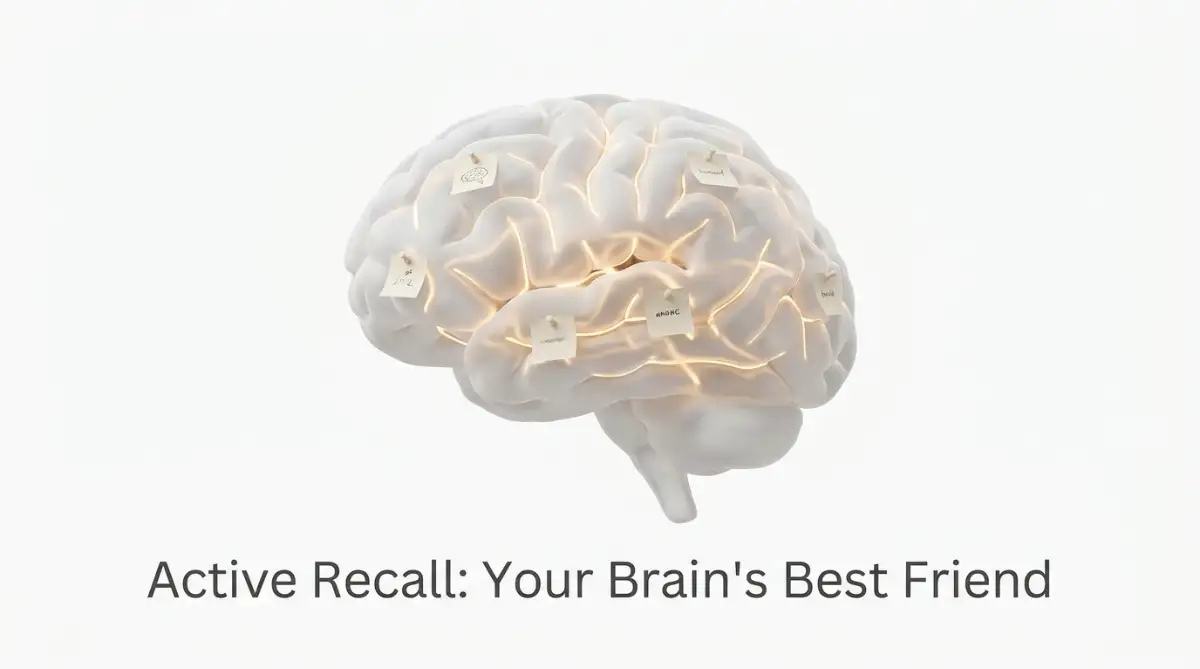
My Quick Study Cheat Sheet
- Stop just rereading your notes—close the book and force your brain to remember the facts on a blank piece of paper.
- Mix up your subjects! Do not study math for five hours straight; switch between different topics every hour to keep your mind sharp.
- Your bed is your best study buddy. Sleep is when your brain actually saves what you learned, so never skip it to cram.
- Turn your phone off and put it in a drawer. Even seeing the blank screen ruins your focus.
The Simple Science of How Your Brain Stores Information
Before we fix your study routine, we need to understand how memory works. Your brain does not work like a computer hard drive.
Instead, it works like a thick forest. If you walk down a path only once, the grass grows back, and the path disappears quickly.
But if you walk down that same path again and again, it becomes a clear trail. In your brain, these trails are called neural pathways.
When you just reread your notes, you are only looking at the path. You are not actually walking on it.
To make the path permanent, you must force your brain to work. You need to pull the information out of your head, not just push it in [1].
This process of pulling information out is what builds strong, unbreakable memories. Let us explore the best ways to do this.
The Power of Forced Remembering (Active Recall)
Most students love to use highlighters. They cover their books in bright yellow and pink ink.
This makes you feel like you are studying hard. However, scientists call this an illusion of competence.
You confuse familiarity with actual knowledge. Just because you recognize the words does not mean you can write them down during a test [1].
Instead of reading, you should use active recall. This means you test yourself on the material before you even feel ready [1].
- Close your book after reading a single page [1].
- Write down three key things you just read on a blank sheet of paper [1].
- Compare your notes to the book to see what you missed [1].
Quick True or False: The Highlighter Trap
- False: Highlighting everything makes it easier to memorize. (This just tricks your brain into thinking it knows the material because the page looks pretty!)
- True: Closing the book and forcing yourself to scribble down what you remember is messy, but it works ten times better than using colorful markers.
This simple act of forcing your brain to search for the answer makes the memory much stronger. It tells your brain that this information is highly important.
You can also use flashcards for this. Write a question on the front and the answer on the back [1].
Do not look at the answer until you have actively tried to say it out loud. It might feel slow at first, but it saves you hours of useless reading [1].
Pro Tip: Try to explain a hard concept to an empty chair or your pet. If you get stuck, you know exactly which part of your notes you need to study again.
Beat the Forgetting Curve with Spaced Practice
Have you ever noticed that you remember something perfectly right after reading it, but forget it the next day? This is due to the Forgetting Curve [1].
A scientist named Hermann Ebbinghaus discovered that we forget up to 80% of what we learn within 24 hours. This is a natural brain function [1].
Your brain cleans out unused information to save space. To stop this, you must review the topic right when you are about to forget it [1].
This method is called spaced repetition. Instead of studying a topic for five hours in one night, you study it for one hour over five different days [1].
This simple schedule keeps the memory path fresh. It moves the facts from your short-term memory into your long-term memory [1].
You will spend less total time studying. Best of all, you will not have to cram the night before the big test.
The Kid-Friendly Explanation Method (Feynman Technique)
A famous physicist named Richard Feynman had a secret weapon for learning hard ideas. He believed that if you cannot explain something simply, you do not really understand it.
We often use big, complex words to hide our own confusion. To truly master a topic, you must explain it as if you are talking to a ten-year-old child.
- Choose your topic: Write the name of the concept at the top of a blank sheet of paper.
- Explain it to a child: Write a simple explanation using basic words. Avoid any technical terms or jargon.
- Identify your gaps: When you struggle to explain a part simply, go back to your textbook to find the answer.
- Simplify with analogies: Use a real-life comparison to make your explanation even clearer.

For example, do not just memorize that "mitochondria produce energy." Say that "mitochondria are like the tiny power stations inside our body's cells."
This technique forces you to see the big picture. It stops you from just memorizing words without knowing what they actually mean.
Double Your Memory Power with Dual Coding
Our brains are highly visual. We find it much easier to remember a picture than a block of plain text.
Dual coding is the practice of combining words with simple visuals. When you study, do not just write down sentences.
Draw a quick sketch, a flow chart, or a diagram next to your notes. You do not need to be an artist to do this.
Even simple stick figures and arrows can help your brain organize the information. This gives your mind two different ways to find the memory later.
You can recall the words, or you can recall the picture. Together, they make your understanding twice as strong.
Why Sleep is Your Secret Study Partner
Many students think that staying up all night is a sign of hard work. In reality, it is a form of self-sabotage.
Your brain does not rest while you sleep. Instead, it goes to work like a night-shift library worker.
It takes all the messy information you learned during the day and organizes it neatly into your memory files. This process is called memory consolidation.
If you do not sleep, this consolidation does not happen. The facts stay in your temporary brain files and disappear quickly.
Aim for at least seven to eight hours of sleep before your exam. A rested brain will always perform better than a tired brain that spent ten hours cramming.
Use Practice Tests to Build Exam Confidence
The best way to prepare for a game is to play the game. The same rule applies to your exams.
Do not just look at past papers and read the answers. Sit down in a quiet room, set a timer, and take the practice test under real exam conditions [1].
This does two great things for you. First, it shows you exactly what you do not know yet [1].
Second, it trains your brain to handle the stress of the clock. When you walk into the exam room, it will feel like a normal practice session [1].
Start small. Even answering five practice questions a day can make a massive difference in your final grades [1].
Master Level Strategies: Deep Brain Hacks for Ultimate Memory Power
When we study, we usually focus on one topic for hours before moving to the next. Scientists call this blocked practice, and it is actually highly inefficient for long-term learning[1]. Instead, you should mix different topics or types of problems in a single study session[1][2].
This method is known as interleaving, and it forces your brain to stay awake and active[2]. According to learning research on interleaved practice from the University of Arizona, mixing similar subjects helps your brain spot the tiny differences between concepts[3][4]. For example, if you are studying physics, do not just solve ten gravity problems in a row[5]. Mix in three thermodynamics problems and five velocity questions instead[2][5].
My Real-Life Study Hack:
When I was trying to pass my biology finals, I stopped studying one chapter all day. Instead, I would do 20 minutes of cell biology, take a quick walk, and then switch to genetics for 20 minutes. It felt super confusing on the first day, but by the end of the week, my brain could easily jump between topics during the real test without freezing up.
It will feel much harder to study this way at first[2]. However, that extra mental effort is exactly what builds strong, permanent memory traces[2]. Think of it like cross-training for an athlete; it makes your mind more flexible and ready for any surprise exam question.
Matching Your Study Mood to the Exam Room
Have you ever wondered why you can remember a fact perfectly at your desk but forget it in the quiet exam room? This is a well-known psychological concept called state-dependent memory on Wikipedia[6]. Your brain associates the facts you learn with the physical environment and your emotional state at that exact moment[7].
If you study in a loud, messy room while listening to high-energy music, your brain stores those cues[8]. When you enter a dead-silent exam hall, your brain struggles to retrieve the facts because those cues are missing[8]. To fix this, try to make your study environment as similar to the actual exam room as possible.
Study in quiet areas, sit at a proper wooden desk, and do not listen to background music. Even matching your stress levels can help you remember facts better under real pressure[7]. Practicing in these realistic conditions makes retrieval during the test feel like a natural habit.
Clearing the Mental Noise of Student Financial Stress
Learning complex scientific formulas is almost impossible when your mind is heavy with daily worries. For most students, unexpected financial expenses and college bills are the biggest sources of mental distraction. When you are constantly worrying about cash, your brain does not have the space to build strong long-term memories.
Once your primary worries are sorted out, your mind is free to absorb and retain information. You can study with a peaceful, calm attitude, which is the most powerful state for remembering complex facts.
Using Sleep to Solve Hard Problems
Have you ever gone to sleep feeling completely confused by a math problem, only to wake up knowing the answer? This is not a coincidence or magic. Your brain continues to work on unsolved puzzles while you are asleep[7].
When you sleep, your brain runs simulations of the things you learned during the day. This process is backed by a major study on memory consolidation in the National Institutes of Health. It links new facts with old memories, helping you find creative solutions to hard questions.
Cutting your sleep short to study more actually deprives your brain of this powerful problem-solving time. Aim to protect your sleep schedule just as much as your study schedule. A rested mind will always perform better than a tired mind that spent ten hours cramming.
The Power of Graphic Learning (Dual Coding)
Our brains are highly visual. We find it much easier to remember a picture than a block of plain text. Dual coding is the practice of combining words with simple visuals.
When you study, do not just write down sentences. Draw a quick sketch, a flow chart, or a diagram next to your notes. You do not need to be an artist to do this.
Even simple stick figures and arrows can help your brain organize the information. This gives your mind two different ways to find the memory later. You can recall the words, or you can recall the picture. Together, they make your understanding twice as strong.

The Dangerous Traps That Quietly Destroy Your Exam Results
Many dedicated students work hard for weeks and still face disappointment on their test scores. This happens because they fall into common learning traps without even realizing it. Let us examine these hidden mistakes so you can protect your grade and save your valuable time.
Falling in Love with Comfort and Easy Methods
The most common mistake is choosing comfortable study habits over active, difficult ones. Rereading your textbook notes or looking at highlighted text feels wonderfully easy [1]. It makes you feel like you are making progress because the words look familiar [1].
However, this comfortable feeling is a dangerous trick. Your brain is not doing any active work, so it will not remember the facts when you need them [1]. If you do not struggle at least a little bit while studying, you are probably not learning.
Force yourself to close the book and try to write down what you learned. This active struggle is where true learning happens. It is much better to make mistakes while studying than to make them during the actual exam.
The Illusion of Perfect Study Organization
Another trap is spending days organizing your desk, making color-coded schedules, and designing flashcards. You spend five hours creating the perfect study system but only ten minutes actually studying. This is a clever form of procrastination that makes you feel productive.
Remember that a messy flashcard that you actually study is better than a beautiful card you never read. Stop preparing to study and start active recall exercises immediately [1]. The best study routine is the one that gets you thinking, not the one that looks the prettiest.
Keep your study tools simple and practical. Do not get lost in the details of planning. Action is the only thing that will get you the grades you want.
Letting Your Phone Steal Your Brain Power
Many students study with their phones sitting right next to their books. They think that checking a quick message for five seconds does not hurt their learning. However, cognitive science shows that even seeing your phone screen reduces your focus.
It takes your brain up to twenty minutes to regain deep focus after a single notification. Turn your phone off completely and place it in another room while you work. Protecting your attention is just as important as choosing the right study habits.

Create a distraction-free zone for your study sessions. When you remove the temptation to check social media, your brain can enter a state of deep, uninterrupted learning. You will finish your work in half the time and remember it much better.
The Panic of Trying to Learn Everything at Once
Trying to cram a whole semester of information into one night is like trying to eat a whole cake in one bite. It leads to extreme mental fatigue and makes it almost impossible to remember anything during the test. This habit creates a state of panic, which triggers your body's flight-or-fight response[7].
When you are panicked, your body releases stress hormones that block your memory recall[7]. This is why students frequently experience a total brain freeze during difficult exams.
To avoid this, break your study material down into tiny, daily tasks. Even fifteen minutes of calm daily study is better than ten hours of panicked midnight cramming. Your brain needs time and peace to build strong, reliable connections.
Your Personal Path to Exam Success Starting Today
You now have a complete, science-backed toolkit to master any difficult subject. You do not need to rely on painful all-nighters or useless memorization habits anymore. Learning is a skill that you can improve with the right practice and a quiet mind.
Treat your brain with kindness by getting enough rest and managing your daily worries. Remember that every small study session you complete builds a stronger, lasting neural pathway. Take a deep breath, trust your new methods, and step into your next exam with total confidence.
Your Fast Action Checklist for Tonight
To help you get started immediately, here is a simple action plan for your next study session:
- Close your textbook right now and write down three main points you remember from this guide.
- Design a quiet study space that looks exactly like your regular classroom.
- Mix two different subjects during your study session tomorrow to start interleaving[2].
- Put your phone in another room before you open your books.
By taking these small steps, you are changing the way your brain works. You are moving away from stress and moving toward real, lasting knowledge. You have the power to master any exam, so start your new journey tonight.
Disclaimer
This guide is designed for educational and informational purposes only. We always recommend consulting with professional academic counselors or financial advisors for specific personalized advice. Our tips do not guarantee specific exam grades but are based on established cognitive science research.