When My Hard Work Was Stolen Overnight: The Brutal Truth of Content Piracy
Waking up to find your exact words, custom graphics, or video scripts copied onto someone else's website is infuriating. You put hours into creating original work, and a lazy copycat steals your search traffic in seconds. I have dealt with content theft on my own sites multiple times, and getting angry never fixes the problem. You need a simple, step-by-step game plan to get your work taken down fast without spending money on expensive attorneys.
They had copied my exact words, my custom graphics, and even my personal stories without asking.
I felt completely helpless, angry, and deeply violated because my weeks of hard work were stolen in a single second.
My immediate reaction was to scream, but then I realized that anger would not fix my broken business.
That painful experience forced me to study the complex world of legal protection for online assets.
This is a quiet nightmare that thousands of creative minds face every single day.
You pour your heart and soul into writing articles, editing videos, or designing graphics.
Then, a lazy competitor copies your work and starts making money from your sweat.
This constant threat can easily steal your mental peace and make you want to stop creating altogether.
You start doubting whether it is even worth sharing your ideas with the world anymore.
The fear of getting copied can freeze your creative flow and ruin your sleep.
But you do not have to live in fear of digital thieves anymore.
There are simple, powerful legal tools designed specifically to shield your business.
Once you understand how these rules work, you can build a strong shield around your brand.
You will feel confident knowing that you have the law on your side.
Let us look at how you can take back control of your creative journey today.
📌 Quick Action Checklist: How to Protect Your Content
- Automatic Rights: You own the copyright to your original writing the moment you hit publish—no costly filing required for basic protection.
- Evidence First: Always grab full screenshots and save timestamped web archive links before reaching out to someone who copied you.
- Two-Step Removal: Start with a calm, direct 48-hour removal email. If they ignore you, send a formal DMCA notice straight to their web hosting provider.
- Search Engine Blocking: If a rogue site refuses to take your stolen post down, submit Google's free DMCA removal form to wipe their URL from search results completely.
Your Legal Shield: Demystifying Copyright and Creative Rights
Understanding the legal basics is the first step to securing your online presence.
Many people confuse different legal terms, which leads to costly mistakes down the road.
Let us break down the main tools you can use to protect your digital empire.
Copyright vs. Trademark: Knowing the Big Difference
Many creators think that getting a trademark protects their blog posts, but that is not correct.
A copyright protects original creative works like articles, videos, music, and photos.
A trademark protects brand names, logos, slogans, and things that identify your business in the market.
If someone copies your logo, you use trademark law to fight them.

If they copy your written content, you must use copyright law to take it down.
Keeping this clear distinction in mind will save you a lot of time and money.
The Power of Automatic Protection
Here is some great news that most people do not know.
You own the copyright to your work the exact moment you create it and save it in a tangible form.
The second you publish a blog post or save a video file, it is legally yours.
You do not need to pay any money or file any forms to have basic copyright protection.
However, proving that you were the original creator can sometimes be difficult without official records.
Why Official Registration is Your Ultimate Weapon
Even though protection is automatic, registering your work with your government's copyright office is highly recommended.
If you ever need to sue someone for copying your work, you must have an official registration.
In many places, registering your content early allows you to claim higher financial damages in court.
It acts as public proof that you are the true owner of that specific piece of work.
Think of it as a cheap insurance policy for your most valuable digital assets.
Practical Steps to Prevent Content Theft on Your Website
You cannot stop every single thief, but you can make your site a very hard target.
Most copycats look for easy targets that offer no resistance at all.
By taking a few simple steps, you can scare away most people who want to steal your work.
Use Clear Copyright Notices Everywhere
Do not assume that everyone knows copying is illegal.
Place a clear copyright notice in the footer of every single page on your website.
Use the copyright symbol, the current year range, and your business name clearly.
An example of this is: "© My Website Name. All Rights Reserved."
This simple text warns honest people and reminds dishonest ones that you are watching.
Disable Right-Click and Copy Functions
You can install simple, free tools on your website that prevent users from right-clicking.
This stops people from easily copying your text or saving your custom images.
While tech-savvy thieves can bypass this, it stops the average copycat immediately.
Making theft even slightly annoying will encourage lazy people to leave your site alone.
Set Up Automatic Plagiarism Alerts
You do not have time to search the internet daily to see if someone copied you.
Use free tools like Google Alerts to track unique sentences from your articles.
You can also use online plagiarism checkers to scan your site regularly.
These tools will email you the moment they find your exact words on another website.
Finding the theft early allows you to act before the copycat ranks on search engines.
Do you want to see exactly how to write a formal legal notice to stop online thieves? Watch this simple, step-by-step video guide to learn how to handle copyright infringements easily.
[Insert YouTube Video Link Here]
How to Handle Content Thieves Without Hiring an Expensive Lawyer
When you find out someone has stolen your work, do not panic.
You do not need to spend thousands of dollars on lawyers to resolve the issue.
There is a clear, step-by-step path you can follow to get your stolen content removed quickly.
Step 1: Gather Your Proof Immediately
Before you contact the thief, make sure you have solid evidence.
Take screenshots of the copied content on their website, making sure the URL is visible.
Save the exact URL of your original post to prove you published it first.
Use online archive tools to save a permanent digital record of their theft.
This proof will be essential if you need to take formal action later.
Step 2: Send a Friendly but Firm Email
Many people copy content because they are uneducated about online laws.
Find the owner's contact information on their website and send a polite email.
State clearly that they are using your copyrighted material without permission.
Provide links to both your original page and their copied page.
Give them a short deadline, like forty-eight hours, to remove your content completely.
Copy-Paste Cease & Desist Template:
"Subject: Notice of Copyright Infringement – Immediate Removal Request
Hi [Site Owner Name],
I am the original author and copyright holder of the article published at [Insert Your URL]. I noticed that your page at [Insert Thief URL] contains my exact text without permission. Please remove this copied material within 48 hours to avoid formal DMCA notices filed directly with your hosting provider and Google Search. Thank you for your prompt cooperation.
Pro Tip: When I first started out, I used to send angry, threatening emails to people who copied me. I quickly realized that taking a calm, professional tone works much faster. Now, I simply state the facts and reference copyright law, which usually gets the content removed in under a day.
Step 3: Use the Power of the DMCA Takedown Notice
If the website owner ignores your email, it is time to use the DMCA system.
The Digital Millennium Copyright Act is a powerful tool that helps creators remove stolen content.
You do not send this notice to the thief; you send it to their web hosting company.
Web hosts are legally required to remove copyrighted content if they receive a valid notice.
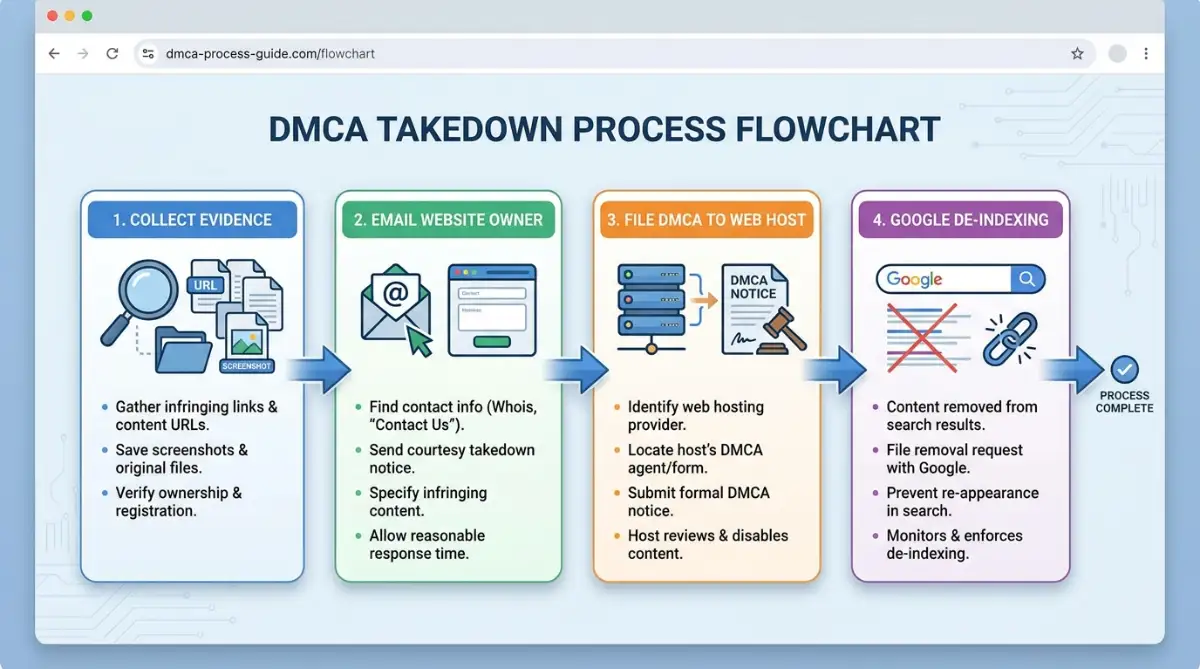
You can easily find who hosts any website by using free online search tools.
Step 4: Contact Search Engines to Remove the Copied Pages
Sometimes, stubborn thieves will use offshore hosts that ignore DMCA notices.
If this happens, you can ask search engines like Google to remove the stolen page from their search results.
Google has a very simple, free online form for reporting copyright infringement.
Once Google reviews your request, they will remove the stolen page from their index.
This completely cuts off the thief's search traffic, making their stolen page useless.
Protecting Your Visual Assets: Images, Graphics, and Videos
Written text is not the only thing at risk online.
Images, infographics, and videos are highly targeted by online content scrapers.
Protecting these media assets requires a slightly different approach than written text.
The Power of Watermarking
Adding a subtle logo or website name to your images is highly effective.
Place the watermark in a position where it cannot be easily cropped out.
You do not want it to ruin the image, but it should be clearly visible.
If someone shares your image on social media, you will get free promotion instead of losing credit.
Use Metadata to Prove Your Ownership
Most digital cameras and design tools embed hidden information inside your files.
This metadata includes your name, creation date, and copyright details.
Even if someone downloads your image and uploads it elsewhere, this hidden data often stays intact.
It serves as strong digital proof that the image belongs to you.
Platform-Specific Creator Tools
Major social media platforms have built-in systems to protect creators.
For example, platforms like YouTube and Facebook have matching tools that scan for copied videos.
If someone uploads your video to their channel, these systems will notify you automatically.
You can then choose to block the video, run ads on it to make money, or track its views.
Make sure to sign up for these creator programs to keep your media assets safe.
Setting Up Clear Terms of Service on Your Website
Your website's Terms of Service page is more than just boring legal text.
It is a binding contract between you and anyone who visits your site.
Having a clear policy on how people can use your content is essential.
Define What is Allowed and What is Forbidden
Clearly explain what visitors can and cannot do with your creative work.
For example, you can state that people can share a small snippet of your text if they link back to you.
State clearly that copying entire articles or using your images for commercial use is strictly forbidden.
This makes your rules transparent and easy to understand for everyone.
How to Create a Terms of Service Page Easily
You do not need to pay a lawyer thousands of dollars to write this page.
There are many free, reliable online generators that can create a basic template for you.
Make sure to read through the generated text and customize it to fit your creative business.
Once created, place a link to this page in your website's footer so it is easy to find.
Building a Safe and Successful Creative Business
Securing your creative work is not about living in constant fear.
It is about setting up smart, simple systems so you can focus on what you do best: creating.
By implementing these legal strategies, you protect your income, your brand, and your sanity.
Take a few hours this week to set up these protections on your site.
You will sleep much better knowing your hard work is safe from digital thieves.
Next-Level Tactics: Pro Secrets to Safeguarding Your Digital Brand
Now that you know the basics of copyright, it is time to look at some advanced protection methods.
Many successful creators use smart technical habits to protect their work before a copycat even gets a chance.
These steps will help you secure your business assets for the long term without spending a fortune.
Secure Your Creation Dates with Digital Timestamps
One of the best ways to prove you created something first is by using digital timestamps.
You can use secure cloud storage systems that automatically record the exact second you upload a file.
These records cannot be changed by anyone, which makes them excellent proof in a legal dispute.
If you are managing your digital assets on a private server, you must keep your systems running smoothly.
Sometimes, server issues can make your files inaccessible when you need them most.
If you run into server problems, you might need help resolving sudden performance bottlenecks in large-scale database management systems to keep your records safe.
Utilize the Power of International Copyright Treaties
You do not only have protection in your own country.
Most nations around the world are members of a treaty called the Berne Convention.
This international agreement means your creative work is automatically protected in over one hundred and eighty countries.
If someone in another country steals your video, you still have the legal right to demand its removal.
For more details on how international copyright treaties work, you can visit the official World Intellectual Property Organization website.
They provide excellent resources that explain how countries work together to stop digital theft.
Knowing these global rules gives you huge peace of mind when sharing your work online.
Watch Out for AI Scrapers and Modern Bots
In today's digital world, automated bots are constantly crawling the web to copy creative work.
Some of these bots scrape your articles to train artificial intelligence models without your permission.
You can block these scrapers by editing a simple file on your website called the robots.txt file.
This file tells search engines and AI tools which pages they are allowed to read and which ones they must ignore.
Understanding how these automated systems read and copy your written words is very interesting.
It is quite similar to the way advanced computer systems process human speech.
If you want to understand this technology better, you can read our guide on how do machines understand us language models explained to see how modern bots analyze text.
Build an Official Content Tracking Sheet
Create a simple spreadsheet where you list every major article, video, or design you publish.
Include the date of publication, the original URL, and a link to a saved backup copy.
This spreadsheet will serve as your master ledger if you ever need to send multiple copyright notices.
It keeps you organized and ready to act quickly whenever a copycat strikes.
Keeping this list updated takes only a few minutes each week.
But having all your proof in one place will save you hours of stressful work later.
It turns a scary legal situation into a simple, organized task.

Blind Spots That Could Destroy Your Creative Business Overnight
Even the most careful creators can make mistakes that leave their work wide open to theft.
Losing your digital assets because of a simple oversight is a heartbreaking experience.
Let us look at some common traps you must avoid to keep your business safe.
Trusting Verbal Agreements with Freelancers
Many creators hire freelance designers or writers to help them make content.
If you do not have a signed written contract, you might not actually own the work you paid for.
In many places, the copyright legally belongs to the creator unless there is a written agreement stating otherwise.
Always use a simple "work-for-hire" contract before paying anyone to create assets for your brand.
Without this written proof, a freelancer could legally demand that you stop using the images or text you bought.
They could even sell those same assets to your direct competitors.
Never rely on friendly video calls or casual chat messages to seal a business deal.
Failing to Inspect Your Brand's Digital Foundation
Just like buying a house, building a digital brand requires a very thorough inspection.
If you ignore the legal setup of your website, your whole business could collapse later.
This is very similar to inspecting a physical property before signing the purchase papers.
Before you invest your time and money into a new project, you must check for hidden problems.
Fixing your legal mistakes early will save you from massive headaches down the road.
Believing the Myth of "Fair Use"
Many people think they can use any image or music track if they only use a small part of it.
They believe that giving credit to the original creator in the description makes it legal.
This is a very dangerous myth that can get your social media accounts banned.
Fair use is a highly complex legal rule, and simply giving credit does not protect you from copyright claims.
If you want to learn more about the limits of fair use, you can study the Stanford Copyright and Fair Use Center resources.
They offer deep insights into what is legally safe to use and what is not.
Always get written permission or use royalty-free media libraries to stay completely safe.
Letting Your Asset Value Drop Over Time
Your creative works are valuable assets that build the overall worth of your online business.
If you let copycats run wild, the market value of your brand will start to drop rapidly.
Protecting your work's market value is just as important as knowing the true worth of a physical property.
When you ignore online thieves, it is like letting your property fall into disrepair.
Keep your digital assets secure so your business worth keeps growing every year.
Your Path to Creative Freedom and Legal Security
Protecting your creative work is one of the most rewarding things you can do for your business.
When you secure your assets, you are telling the world that your ideas have real value.
You do not need to be a lawyer to start using these simple protective measures today.
Begin by adding copyright notices to your pages and using search alerts to track your content.
If you find someone copying you, handle the situation calmly using the simple email steps we discussed.
By building these habits, you will create a safe space where your creative brand can truly thrive.
I used to spend countless sleepless nights worrying about copycats ruining my online business.
Once I set up these simple legal safeguards, I felt a massive weight lift off my shoulders.
My best advice to you is to take action today and protect the digital empire you are working so hard to build.
Simple Answers to Common Legal Questions
Can I copyright a blog post title or a short catchphrase?
No, copyright law does not protect short titles, names, or phrases. If you want to protect a unique brand name or slogan, you must apply for a trademark instead. Copyright is strictly reserved for longer, original creative works like full articles, books, and videos.
What should I do if a host ignores my DMCA notice?
If a web host ignores your legal request, you should file a removal request directly with search engines like Google. This will remove the stolen page from search results, which stops their traffic. You can also contact the payment processors or ad networks active on the thief's site to report the illegal activity.
Does changing a few words in an article bypass copyright law?
No, simply changing a few words or rearranging sentences is still considered copyright infringement. This is known as creating a "derivative work" without permission from the original owner. If the core ideas and structure are clearly copied from your work, you still have the legal right to take action.
Is my work protected if I publish it under a pseudonym?
Yes, your creative work is completely protected even if you use a pen name or publish anonymously. The law protects the actual creator of the work, regardless of the name you display online. Just make sure you keep the original drafts and file records to prove you are the real person behind the pen name.
Where can I register my work officially to get maximum legal protection?
You can register your work with your national government's copyright agency, such as the U.S. Copyright Office. The registration process is usually done online and requires a small fee along with a copy of your work. Having this official certificate is the strongest proof you can hold in a legal dispute.
Important Legal Disclaimer
The information provided in this article is for general educational purposes only and does not constitute formal legal advice. I am a content creator and SEO expert, not a licensed attorney. Laws can vary greatly depending on your location, your industry, and your specific business situation. If you are facing a serious legal dispute or need official contracts drafted, please consult with a qualified intellectual property lawyer in your local area.